
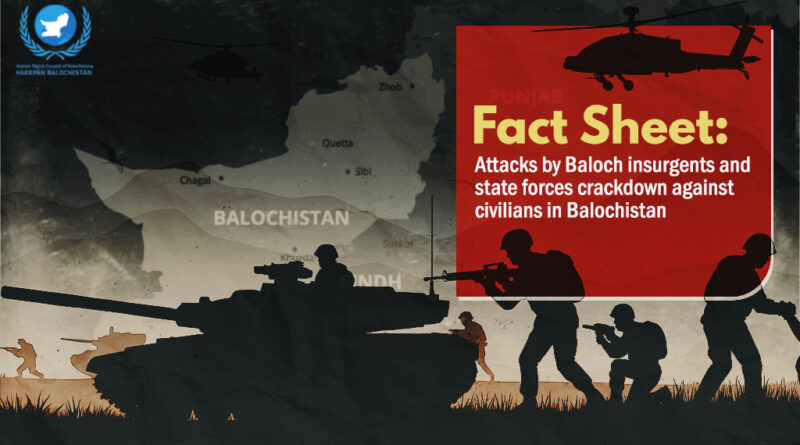
Fact Sheet: Attacks by Baloch insurgents and State’s crackdown against civilians in Balochistan
On 31 January 2026, the Baloch Liberation Army (BLA), an armed nationalist group, launched more than twelve simultaneous and coordinated attacks in different cities of Balochistan, including Quetta, the provincial capital. These attacks are considered a huge failure of the state’s security apparatus, as Balochistan has been heavily militarized for more than two decades. As a retaliation for such incidents, the state has always been targeting the civilian population, while shutting down the internet and all means of communication.
Political and human rights activists are abducted, disappeared, and jailed on bogus cases. Their family members are punished. The entire population of Balochistan is facing the wrath of the military for its failure.
Since 31 January, the security forces have been attacking civilian populations in different regions of Balochistan.
We will bring you updates from the ground. Please follow this fact sheet, which we will update with every progress.
Total Number of casualties, including Enforced Disappearances:
- Killings
- Targeted and Indiscriminate Killings: 37
- Killed After Enforced Disappearance: 23
- Total Killings: 60
- Enforced Disappearances
- Enforced Disappearances: 186+
- Released: 11
- Handed Over to Police: 2
- Other Violations
- Injuries: 25
- Houses Destroyed: 10
Districts affected the most:
Quetta, Gwadar, Nushki, Kech, Khuzdar, ….
Brief notes on the Incidents:
February 01:
- Security forces reportedly carried out an assault on a residential compound housing laborers, leaving two families from district Khuzdar severely affected. The operation resulted in the deaths of 12 people, including women and children, and left nearly 10 others injured. Among the deceased were Noor Muhammad Faqeer Zehri, son of Mulla Jaorak, his son Ghulam Yaseen, and one additional male victim. The attack also claimed the lives of four women and five children, while the majority of those wounded were women and children.
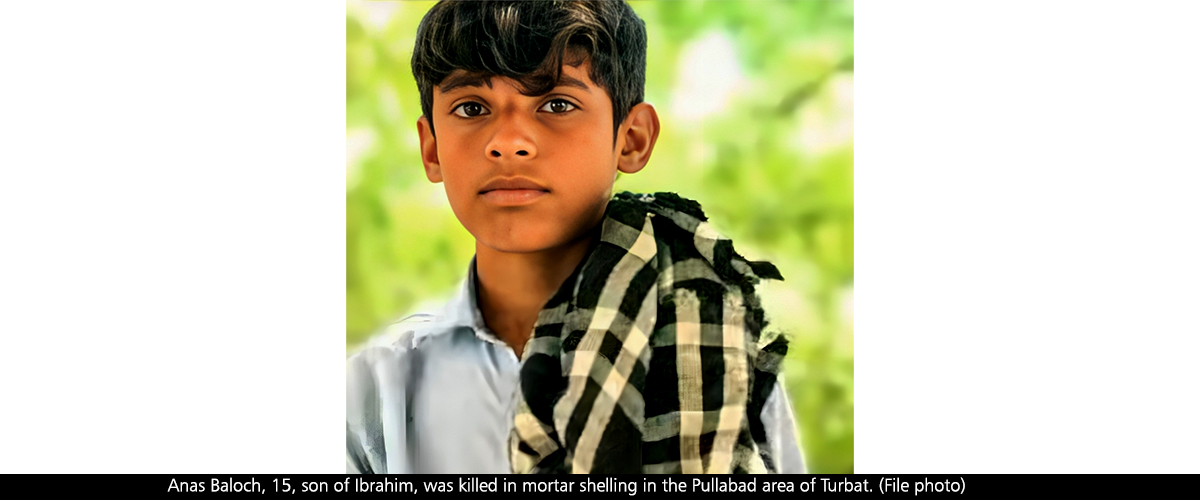
- In Turbat, forces shelled the civilian neighborhood of Pullabad with mortars, resulting in the death of 15-year-old Anas Baloch, son of Ibrahim. The shelling also left a five-year-old child and two women critically wounded. After the attack, forces reportedly proceeded to destroy residential homes in the locality.
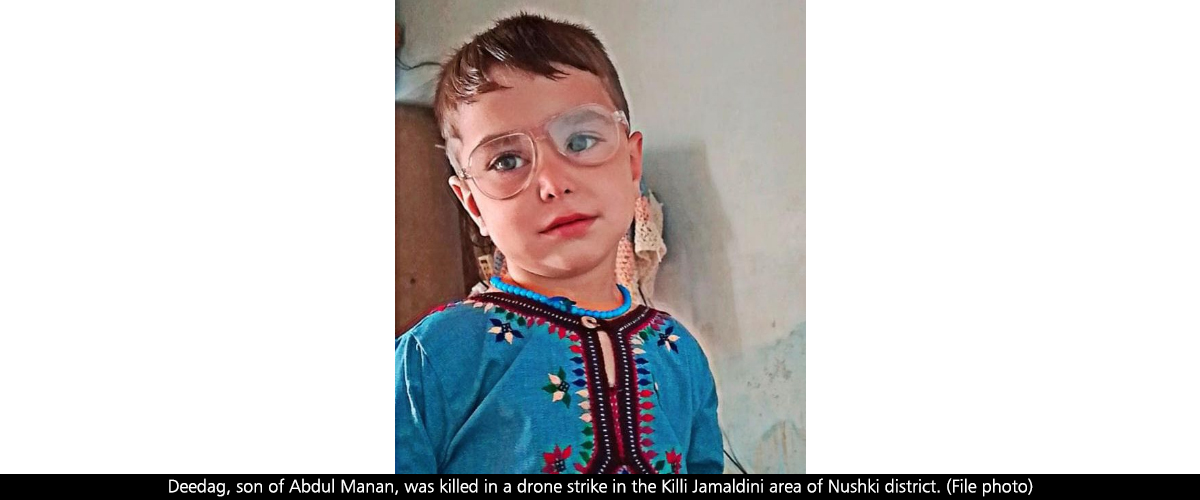
- A child was killed in a drone strike in Nushki district, Balochistan. Local sources reported that the incident took place in the Killi Jamaldini area, where a house was targeted. The child has been identified as Deedag, son of Abdul Manan. According to reports, on February 1, Pakistani forces carried out more than 20 drone strikes, accompanied by firing and shelling from helicopters.
- Pakistani forces opened fire on a passenger vehicle near Cadet College in the Nushki area of Balochistan, resulting in the killing of ten people traveling in the vehicle. The bodies were taken into custody by local authorities and shifted to a hospital. The victims have not yet been identified.
- Pakistani forces fired on civilian areas in Turbat, with rockets launched from a forces’ camp reportedly landing directly in populated neighborhoods, injuring several people. In incidents across different areas, 11 individuals, including three women and three children, were taken to hospital, while three critically injured patients were shifted to Karachi for further treatment, and the rest are receiving care at Turbat Teaching Hospital.
- Personnel of the Counter Terrorism Department (CTD) forcibly disappeared Umair Baloch, a 20-year-old student and son of Abdul Rauf, on 1 February 2026. They abducted him at around 4:00 p.m. from the Burma Hotel near Munir Ahmed Chowk, Quetta. He was a resident of Kili Qambrani, Quetta.
- Pakistani forces extrajudicially killed Karim Jan, son of Malang, also known as Jasim, in Balgater, Kech, on 1 February 2026, after weeks of unlawful detention. He had earlier been abducted from Turbat Plus Market on 2 January 2026, when security personnel forcibly disappeared him from public view.
February 02:
- In a pre-dawn operation on 2 February, around 3:30 a.m., forces carried out coordinated raids on several residences in Hub Chowki, Balochistan, resulting in the enforced disappearance of retired Deputy Commissioner Mohammad Bakhsh Sajidi, his brother Naeem Sajidi, and Engineer Rafeeq Baloch, who previously served as Chief of Sui Gas Balochistan. Mohammad Bakhsh Sajidi is the father of Dr. Naseem Baloch, Chairman of the Baloch National Movement, while Naeem Sajidi and Engineer Rafeeq Baloch are his uncles.
- A 25-year-old resident of Suhrabi Ward in the coastal city of Gwadar, Miran, son of Asghar, was forcibly disappeared by Pakistani forces around 9:30 in the morning. Miran was a fisherman by profession.
- Security forces forcibly disappeared Yasir Arfat, a resident of Miani Kalat, Mashkay (Awaran District), while he was traveling from Hub Chowki to Karachi. He was a 7th-semester student at Gomal University, Dera Ismail Khan
- Khuda Bakhsh, an 18-year-old student, son of Dilwash and a resident of Gaddani, Hub Chowki, was abducted from Karachi at around 10:00 a.m. by Military Intelligence (MI).
- CTD personnel abducted Ilyas Baloch, a student and son of Mir Sultan Mullazai, from his home in Killi Ghazgi, Mastung, at around 2:00 a.m. He is a resident of Killi Ghazgi, Mastung.
- Dawood Lehri (15), son of Muhammad Azum, and his cousin Yasir Lehri, son of Muhammad Hanif, were fired upon by FC personnel in Lakpass, Mastung. Both worked as tailors. During the incident, Yasir was shot dead in broad daylight. After the shooting, Dawood was forcibly disappeared. Yasir’s body was not returned to his family.
February 03:
- On 3 February 2026, the mutilated body of Jasim Jan, 28, a laborer from Panjgur, was found in Washbood. He had been forcibly disappeared on 21 January 2026 after being abducted from his hometown by members of a state-backed death squad, and remained missing until his killing.
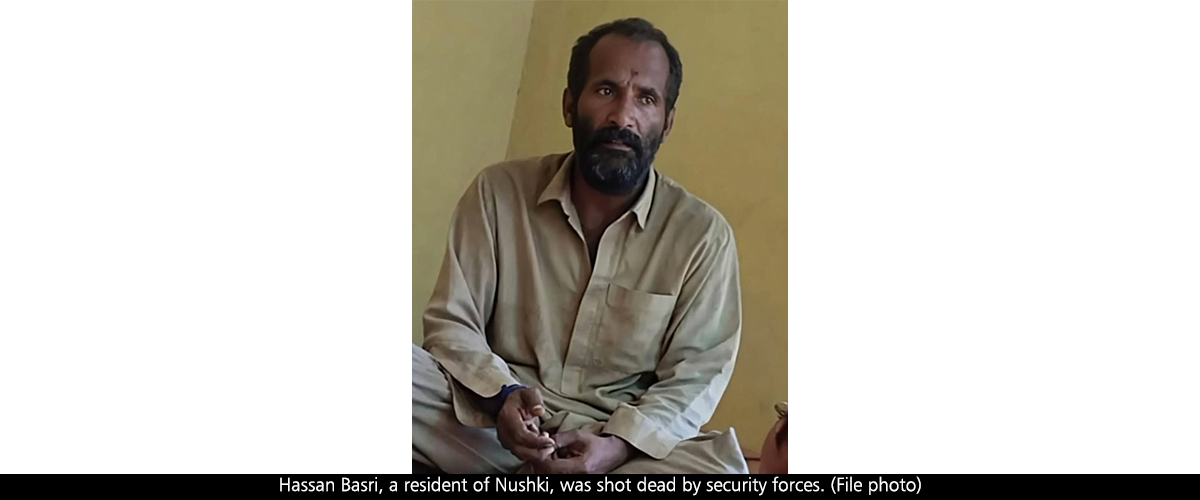
- An ambulance from Nushki Teaching Hospital was fired upon by the forces, severely injuring the driver, Hashmat Ali. Earlier, another ambulance was targeted near Cadet College Nushki, where the driver was shot and killed on the spot.
Hassan Basri, a resident of Nushki and the brother of prominent Brahvi singer Hussain Naseer, was shot dead by security forces.
- Security forces took a 15-year-old student Hasnain Baloch, son of Babul Jan, into custody and disappeared him. He was detained from Killi Asgharabad, Sariab Customs area, Quetta.
Tariq Hussain, son of Muhammad Sharif Bugti and a resident of the Pat Feeder area of Dera Bugti, was forcibly disappeared from Shaikh Zayed Hospital, Larkana, where he had gone for his children’s medical treatment. He was reportedly taken by personnel of ISI. - Babu Atta Muhammad Badini, a 60-year-old resident of Killi Qazi Abad, Nushki district, Balochistan, was killed when Pakistani forces opened fire in the area.
- FC personnel abducted Usman Baloch, 20, son of Mehboob, a shopkeeper, from his shop on Dasht Mastung Road, Mastung. He was later released on February 20, 2025.
- Personnel of MI and ISI abducted Imdad Seyad, a 25-year-old custom employee and son of Seyad Muhammad, from Koh-e-Murad Zeyarat in Turbat at around 6:30 p.m. He was a resident of Balgatar, Kech.
February 04:
- A minor, Shahzad Ahmad, son of Zafar Ahmed, was reported killed in firing by forces in Qaziabad, Nushki.
Forces abducted Bakshi Baloch, a resident of Hoshap Talsar, from Shapuk, killed him in custody, and later dumped his body. - Balach Baloch, son of Khalid and a resident of Momin Mohalla, Turbat, was shot dead in a targeted attack at the Singanisar graveyard while offering Fatiha on the first anniversary of Baloch scholar Allah Dad Wahid. Local sources stated that unidentified armed motorcyclists linked to a state-backed “death squad” carried out the attack and fled the scene. Balach had previously been forcibly disappeared twice by the Pakistan Army and had survived at least two earlier assassination attempts prior to his killing.
- Kareem Bakhsh Shah, 28, son of Rafiq Shah, and a resident of Rudhon, Tump, was shot dead by the Frontier Corps (FC) in Gwadar.
- Zahid, son of Abdul Rahman, a 26-year-old fisherman and resident of Gowatri Bazar, Jiwani, Gwadar, was forcibly abducted from his home at around 1:00 AM. According to local sources, the abduction was carried out by personnel of the Frontier Corps (FC) and Military Intelligence (MI).
- Faizuddin Shah, son of Sayyed Yaqoob Shah, a 26-year-old teacher and resident of Kharan City, Kharan, was abducted by the Personnel of MI from the Ghaos Abad area of Quetta. He was later released on 20 February.
February 05:
- Asadullah, a 25-year-old BS student at the University of Balochistan and son of Zafarullah Kurd, was abducted by Counter Terrorism Department (CTD) personnel in plain clothes from the Brewery Road area of Quetta on the night between Wednesday and Thursday, according to family sources.
- Security forces have reportedly detained more than one hundred individuals during operations carried out in various areas of Quetta and transferred them to undisclosed locations. Meanwhile, the provincial government has claimed that around one hundred ‘suspected persons’ were arrested and that small and large weapons were recovered from several houses; however, no evidence was provided to the media to substantiate these claims.
Statements by State Officials and the BLA. - Wahid, son of Muhammad Karim, a resident of Kotu in Jhao district, Awaran, was abducted by FC personnel in a late-night raid on his house. The operation reportedly involved the destruction of household property and the looting of valuables before he was taken away.
February 06:
- Siraj, son of Ghafoor, a 20-year-old student and resident of Khosar Bazar, Jiwani, Gwadar, was forcibly abducted from his home at around 10:00 PM. According to local sources, the abduction was carried out by personnel of the FC and MI. He was released on 11 February.
- Authorities in Nushki imposed a curfew from 5:00 PM to 9:00 AM.
- Muhammad Fareed Baloch (20), a student and son of Muhammad Anwar Baloch, was extrajudicially killed on 6 February, and his body was later dumped in the Jangle area of Killi Safar Ali, Duki. FC and CTD personnel had abducted him on 4 June 2025 from his home, after which he was held in illegal custody and subjected to enforced disappearance for months. His father, Muhammad Anwar Baloch, a farmer, had also been abducted on the same day from a mosque near their home and was later extrajudicially killed on 4 January 2026.
- FC personnel abducted Zafar Ullah, 18, son of Umar Shah and a driver from Qazi Abad, Nushki
- FC personnel abducted Mahmood, 24, son of Haji Noor Ahmed and a resident of Killi Badal Karez, Nushki, from his home at around 10:00 p.m.
February 07:
- Pazeer Baloch (32), son of Muhammad Amin and a resident of Washbood in Panjgur, was extrajudicially killed after months of enforced disappearance. He had been abducted in November 2025 from his residence, allegedly by state-backed death squads, and held in illegal custody before his killing.
- Nadil Baloch, son of Khair Mohammad and a labourer from Kuhado Jhao, was forcibly disappeared during a house raid by forces in Daro Hotel, Hub Chowki. He had previously been abducted in 2019 and detained until 2021, and continued to face harassment.
- Mir Balach, son of Ghulam Jan from Faqir Colony, Karachi, was taken into custody at Karachi Airport under the pretext of visa verification after arriving from Dubai and subsequently went missing. His family said he had returned home to get married and spend the holidays, and when they inquired with airport authorities, they denied having any information about him.
February 08:
- Personnel of the CTD and FC abducted Sohrab Baloch, a 33-year-old laborer and son of Muhammad Amin, from Baloch Colony, Hub Chowki, at around 2:00 p.m. He is a resident of Dazin, Tump, Kech.
- A mutilated body was found in Kochag, Buleda, on 8 February 2026, identified as Nisar, son of Adena and a resident of Alandoor, Buleda. He was reportedly forcibly disappeared by a death squad and killed the same day.
- On 8 February 2026, late at night, FC/Army personnel carried out a raid in Gulshan Ameer Abad, Hub Chowki, abducting nine individuals: Abdul Raziq, son of Jumma Khan, a 41-year-old former watchman at the Session Court; Abdul Malik, son of Jumma Khan, aged 40; Nawroz Khan, son of Abdul Raziq, a student; Jahangeer, son of Muhammad Raheem, a student; Abdul Rab, son of Jumma Khan, a 49-year-old former Superintendent at the Session Court; Muhammad Raheem, son of Jumma Khan, a 50-year-old Senior Clerk at the Session Court; Shaziab, son of Abdul Rab, a student; Shameer, son of Abdul Raziq, a student; and Dad Shah, son of Fazal Kareem, a student and resident of Gazgi, Khuzdar.
February 09:
- Shehroz Baloch, a 22-year-old auto mechanic, son of Obaid Ullah and a resident of Lore Karez Sariab, Quetta, was abducted from his home at around 1:00 a.m. The abduction was carried out by personnel of the Counter Terrorism Department (CTD).
- FC personnel abducted Taimoor, 26, son of Imam Bakhsh, and Murtaza, 31, son of Yahya. Both are farmers from Marap, Surab. They were taken together at around 5:00 p.m. from Mall FC Choki on Main RCD Road in Surab.
- FC and MI personnel forcibly disappeared Ghalib, son of Haji Badal, during a house raid in the Allangi area of Mashkay, Awaran. He was a resident of Gajjar in Mashkay and a student in Quetta who had returned to his hometown to attend a relative’s wedding.
- Murad Bakhsh, son of Mahmood Baloch, and his two sons, Amjid Baloch and Lateef Baloch, were forcibly disappeared by security forces during a house raid in Awaran on 9 February. The family had previously been forced to relocate from their native village, Doliji in Jhao.
February 10:
- MI personnel forcibly disappeared Yasir Lehri, a 26-year-old police constable and son of Abdullah Lehri. He was a resident of Khardan, Kalat, and abducted from Mughalzai Main RCD Road, at around 6:30 p.m.
- Under orders from security forces, citizens arriving from Balochistan have been denied hotel accommodation in Karachi. Reports indicate that people from remote areas of Balochistan have been refused rooms at multiple hotels and lodging facilities across the city.
- Following a week of militant attacks, security forces imposed a curfew in Nushki city, ordering shops to remain closed and confining residents to their homes. They entered the city with tanks and armored vehicles and began demolishing houses. Among the homes destroyed was the ancestral house of Baloch Liberation Army (BLA) leader Bashir Zeb in the Ahmadwal area, and another house in Qaziabad, reportedly vacant since 2011, which belonged to Haji Abdul Samad, who reportedly died in 2009.
- Khuda-e-Raheem (33), a farmer from Sheesha Daghar, Kalat, and son of Haji Ghulam Mustafa, was abducted at around 5:00 p.m. from Mughalzai on Main RCD Road, Quetta, during an operation carried out by Army personnel.
- Ghaffar Baloch, a 16-year-old student and son of Abdul Jabbar from Sheesha Daghar, Kalat, was abducted on February 10, 2026, at 5:00 PM from Shopping Road, Kalat, by the FC.
February 11:
- Abdul Haq, 21, son of Ghulam Nabi, and Kamran Baloch, 22, son of Haji Muhammad Hassan, both students and residents of Killi Jamal Abad, Nushki, were abducted during a house raid at around 4:30 p.m. by FC, MI, and CTD personnel.
February 12:
- Kamal Dad, son of Haji Dad Muhammad, a 25-year-old driver from Sholeeg Dasht, was targeted and killed by a state-backed death squad in Kontani, Gwadar. He had been forcibly disappeared in 2025 and released after one month of illegal detention. Following his release, he survived an earlier assassination attempt in Fakir Colony, where he sustained injuries.
- Shah Zaman, 18, and his brother Naseer Ahmed, 24, both students and sons of Abdullah from Killi Jamal Abad, Nushki, were abducted from their home by FC, MI, and CTD personnel.
- Agha Shahid Ali and Agha Lal Shah were taken into custody by security forces in Quetta and transferred to an unknown location. Both are nephews of Agha Muhammad Shah, vice president of the National Party from Tehsil Saryab
- Forces continue raids and demolishing houses in Nushki, destroying the guesthouses of Haji Bahadur Khan Mengal, BNP central leader and Central Executive Committee member, and Mir Muhammad Ali Khan Mengal, current District Chairman. These actions have raised serious concerns among local civilians.
- Muneer Ahmed (23), son of Shakar Khan, a shopkeeper from Ornach, was abducted at 8:30 p.m. from Sattar Hotel in Khuzdar. He was taken by MI personnel.
- Fazal Jan, son of Abdul Ghaffar, and Gul Muhammad, son of Barkat, residents of Rik Kaherin, Bal Nigwar, Dasht, Kech, were forcibly disappeared by FC at the Doro Kandag checkpoint while returning from Gwadar. Both were involved in the oil trade.
- Forces abducted 18-year-old Ijaz Baloch, son of Abdul Ghafoor, from his home in Kolwa Aashal, Kech, around 2 a.m. He is the younger brother of Nawaz Baloch, who was also forcibly disappeared on February 15 while traveling from Turbat to Kolwa.
February 13:
- Noor Jan, son of Laku and a resident of Chibbi in the Jaho area of Awaran district, was extrajudicially killed by the forces, and his body was handed over to his family on 13 February at a military camp in Gajjar Mashkay. He had been forcibly disappeared from his home on 30 September 2025.
- State-backed death squad members abducted Zulfiqar, 23, son of Hameed and a resident of Tasp, Panjgur, from Tasp Bazar, Panjgur, at around 7:00 p.m.
- Military forces demolished the house of Noor Bakhsh Kalmati in Panwan, a coastal area of Gwadar, using heavy machinery. The family reported that the operation continued until around 3 a.m., with a large number of Pakistani forces present. They added that Tariq Kalmati, a family member, had been forcibly disappeared last year and later recovered, and that other relatives have also been detained or disappeared in separate incidents.
February 14:
- Nawab Abdullah, an FSc student, was extrajudicially killed by FC personnel and state-backed death squads, and his body was dumped in Washbodh, Panjgur. He had been forcibly taken from his home on 29 May 2025 in front of his mother and sisters.
- Security forces carried out house-to-house searches in Nushki, during which at least twenty-two people were taken into custody and transferred to unknown locations. The operations targeted residents in Killi Mengal and Qadirabad, where multiple homes were reportedly broken into, vandalized, and occupants beaten. The identities of those forcibly disappeared are not yet confirmed, as the area remains under siege by the forces.
- Muhnas Baloch, a 17-year-old student and son of Master Zafar, was reportedly killed in a targeted attack by death squads in Tump, Kech.
- Junaid Ahmed, son of Ali Ahmed, a 22-year-old student from Surab, was forcibly disappeared on January 23, 2026, after being taken from the Children’s Hospital in Quetta by personnel of the Eagle Force and the CTD. He was extrajudicially killed. His bullet-riddled body, with hands and feet tied, was later dumped on the Eastern Bypass.
- Faraz, son of Bahadur, a 23-year-old resident of Koshqalat, was shot dead by a state-backed death squad in Chagoogi, Tump. He was an embroidery pattern artist.
- Mir Abdul Razzaq (54), son of Haji Azad Khan Badini, a landlord from Qadirabad, Nushki, was abducted from his home at 10:30 a.m. on 14 February 2026. The abduction was carried out by personnel of the Army, FC, MI, and CTD.
February 15:
- Jangiyan Baloch, a matric student and son of Abdullah Rashed, was extrajudicially killed in Panjgur. He was forcibly disappeared on May 26, 2025, from Janeen Paroom, after being taken by a death squad allegedly operating with personnel of the FC. His body was later found dumped in the Shapatan area of Panjgur.
- Sarfaraz Barech (27), son of Muhammad Jan, a shopkeeper; Rauf Khan Barech (30), son of Muhammad Rafique, a union counselor; and Muhammad Saleh Barech (28), son of Raaz Muhammad, a laborer, all residents of Ghareebabad, Nushki, were abducted during a house raid at 9:30 a.m. They were taken by FC, MI, and CTD personnel and transferred to an unknown location.
- Shazaib Baloch (18), son of Muhammad Hayat, a mechanic from Ghareebabad, and Sameer Ahmed (14), son of Zahoor Ahmed, a student from Ghareebabad, were abducted from their homes in Nushki. Shazaib was taken at 4:00 p.m., while Sameer was abducted earlier at 12:30 p.m. Both were taken by FC, MI, and ATF personnel and transferred to unknown locations. Shazaib was later released on February 23.
- Abdul Rahman, son of Haji Hafeez Ullah, a 20-year-old student and resident of Killi Qazi Abad, Nushki, was abducted from Chaghi Stop Bazaar, Nushki. He was taken by personnel of the Army, ISI, FC, and CTD.
- Ali Asghar, son of Sanjar Khan, a 21-year-old student, and Irfan, son of Mir Khan, a 21-year-old mechanic, both residents of Burma Hotel, Gareeb Abad, Saryab, Quetta were abducted by the personnel of MI and CTD at approximately 4:00 AM from their residence.
- On the night of 15 February, Shahbaz Khan, son of Mohammed from Raage Tanake, Washuk, was shot dead at his home by a state-backed death squad. His brother Barkat had reportedly been killed by the same group in 2018.
- Nawaz Baloch, son of Abdul Ghafoor, was forcibly disappeared by forces while traveling in a local vehicle from Turbat to Kolwa.
February 16:
- Abdullah (17), son of Abdul Hameed Baloch, a student from Koh-e-Sar Bazaar, was abducted at 1:00 a.m. from his home in Jiwani by FC and MI personnel. He was later released on February 21, 2025.
- Sudais, son of Suleman Khan, a 17-year-old student from Sasoli Town, Ziarath Dastageer, Nushki, was abducted on 16 February at around 2:00 PM from Killi Batto, Nushki. He was reportedly taken by personnel of the FC and MI.
- Adil, son of Saleh, a 23-year-old mobile repairer from Kohsar Bazaar, Jiwani, was abducted from his home at around 4:00 am by personnel of FC and MI and transferred to an unknown location. However, He was later released on February 21, 2025.
- Daniyal Nasir, 26, son of Abdul Nasir, a student; Mohammad Iqbal, 28, son of Khaliq Dad, a doctor; and Irshad Ali, 26, a student, all residents of Jaffarabad, were abducted in the morning of 16 February from NCCI Hospital in Karachi by ISI and CTD personnel. Mohammad Iqbal and Irshad were later released on February 19, while the whereabouts of Daniyal Nasir remain unknown.
February 17:
- The Counter-Terrorism Department of Sindh Police has claimed that four alleged “terrorists” were killed during a gun battle on the night of 16 February 2026 in Karachi. Three of the victims have been identified as Jalil Noor Mohammad, Niaz Qadir Bakhsh, and Hamdan Muhammad Ali, all of whom had been forcibly disappeared from Karachi on 29 December 2025 and were later held in the custody of the CTD.
- Nazeer Ahmed, son of Ali Hassan, a 35-year-old farmer from Sheerinza Patk, Basima, Washuk, was abducted from his home at around 5:30 pm by a death squad.
- Security forces have deployed in large numbers in Nushki, conducting a search operation in Qaziabad and raiding homes. They have established checkpoints across the city, patrolling streets and conducting strict searches on all vehicles entering and leaving. A curfew is already in effect.
February 18:
- Budda Lashari, son of Muhammad Murad, Makhan son of Mureed Lashari, and Akbar Domki, son of Nawab Domki, along with three other previously disappeared individuals, were killed in a staged encounter by the CTD in Barkhan district, Balochistan, on February 18. Budda Lashari had been forcibly disappeared from his home in Lehri, Sibbi, nine months earlier, while Akbar Domki, a labourer from the same area, had been forcibly disappeared in 2024 for the second time. He was once disappeared in 2022 along with his brother, Jaisaph, who was also killed in an encounter in Naseerabad.
- Kashif, a 30-year-old shopkeeper from Kalri Lyari, Karachi, son of Yaqoob, was forcibly disappeared for the second time on February 18, 2026, at around 2:00 a.m., after being abducted from his home by Rangers and MI personnel. He was released the following day, on February 19, 2026, after being held in illegal custody.
- Daulat Baloch, son of Badal, a farmer from Tejaban Singaband, Kech, was shot dead in a targeted killing by members of a death squad at around 2:00 p.m. while returning home. He had previously been forcibly disappeared in March 2022 along with his 12-year-old brother by the Frontier Corps and was held for a month before being released.
- Yasir, 24, son of Aziz Baloch, a fisherman from Paleri, Gwadar, was abducted from his home around midnight by FC and MI personnel.
- Security forces carried out a violent operation in the Killi Sharif Khan area of Nushki, demolishing Nazir Ahmad Badini’s house with heavy machinery. During the raid, women and children were subjected to indiscriminate violence, and Nazir Ahmad Badini was forcibly disappeared. Badini is the father of well-known poet Absar Baloch. His young son, prominent football player Balach Badini, had been forcibly disappeared earlier and was later killed in May 2024 by a “death squad” operating under Pakistani intelligence supervision.
- Late at night, FC/Army personnel abducted Fazal Kareem, son of Muhammad Ameen, a 48-year-old police employee, along with his wife Hayat Bibi, daughter of Ahmed, a 42-year-old housewife, and their son Nawaz Shareef, a 28-year-old police clerk, from Gazgi, Khuzdar.
- The Pakistan Army reportedly conducted a house raid in Kuhado Jhao, District Awaran, during which two brothers, Saadullah and Lal Jan, sons of Peer Jan, were forcibly disappeared; both were farmers who had been working on their land.
February 19:
- Abid Abidi, son of Haji Huzoor Bakhsh, a resident of Killi Khairazai, Kishangi, Nushki, was abducted on 15 February. He was later released on 19 February.
- Junaid Baloch, son of Shah Muhammad, a 32-year-old government servant from Killi Qambrani in Quetta, was abducted from his home at around 1:00 am by CTD personnel.
- Haleem, a 30-year-old shopkeeper and son of Muhammad Saqid from Panjgur, was abducted at 9:30 PM from Khudabadan Masjid in Panjgur by a death squad.
- Baba Jan, a 29-year-old driver and son of Muhammad Jan from Killi Qambrani, Qambrani Road, Quetta, was abducted at 2:00 AM from Killi Qambrani, Qambrani Road, Quetta, by personnel of the CTD, FC, and ATF.
- Amir Baloch, son of Ahmed Yar, a 24-year-old student residing in Killi Khuda Raheem, Dalbandin, Chaghi, was abducted from Killi Qasum Khan Dalbandin, Chaghi, on 19 February 2026 at 5:00 PM by the ISI.
February 20:
- The tortured bodies of Murtaza, son of Yahya, 31, and Taimoor, son of Imam Bakhsh, 26, both farmers from Marap, Surab, were discovered on February 20, eleven days after they were abducted together by FC personnel on February 9 from Mall FC Choki on Main RCD Road in Surab. Both bodies showed clear signs of brutal physical torture, indicating severe mistreatment while in custody.
- Saeed Baloch, son of Muhammad Gull, a 23-year-old laborer from Killi Qambrani Barzai, Quetta, was abducted from his home at around 1:00 am on 20 February 2026. He was taken by CTD personnel.
- Security forces launched operations in Tump, Kech, and Lijjay, Kharan. They reportedly cordoned off areas, raided homes, and seized jewelry and valuables. They also demolished and set fire to houses, using violence against civilians, including women.
- The bullet-riddled body of Jahanzeb, son of Muhammad Ali and a resident of Isa Sorg, was found near a date factory on the CPEC road in Panjgur. He was reportedly killed while in the custody of the forces, having been forcibly disappeared by death squads on October 13, 2025.
February 21:
- Ghulam Sarwar, son of Eidoo, a 33-year-old labour residing in Abdullah Bizenjo Goth Sakuran, Hub, was abducted from Abdullah Bizenjo Goth Sakuran, Hub, on 21 February 2026 at 3:00 PM by the MI.
- According to reports from the coastal district of Gwadar, Pakistani forces demolished the house of a man named Muhammad in Pasni Grani, in district Gwadar, destroying the property.
Statements by State Officials and the BLA
February 01:
- Balochistan Chief Minister Sarfaraz Bugti stated on television that the situation in Balochistan is not a political issue and should be dealt with solely through military means. He warned that the families of militants would face collective punishment if they failed to inform the authorities about the involvement of their relatives in separatist groups. He also stated that 140 militants had been killed in the operation.
February 02:
- Defence Minister Khawaja Asif said on Monday that Pakistan needed to deploy large numbers of troops in Balochistan because of the province’s vast geography amid the serious security situation and recent spate of attacks.
- The Balochistan Liberation Army (BLA) released an infographic claiming it had conducted coordinated attacks across 16 cities in Balochistan. According to the group, it carried out 64 operations targeting state and security installations within 69 hours, resulting in the deaths of 220 security personnel, the capture of 17, and the loss of 27 of its own fighters. The BLA has continuously shared videos of clashes, as well as images and details of its deceased fighters, on social media. In contrast, government officials claim that around 150 militants have been killed so far. On February 1, Sarfaraz Bugti stated that the operation had been successfully thwarted by security forces and that the situation had returned to normal. However, the BLA asserts that, on the fifth day of the operation, its fighters maintain control over many areas, including Nushki city.
February 05:
- The Pakistan Army’s media wing, ISPR, has claimed that the operation in Balochistan concluded on the sixth day with the killing of 216 militants without providing details to substantiate the claims. However, the Baloch Liberation Army (BLA) has rejected these claims, stating that the attacks are still ongoing.
February 06:
- BLA announced the end of its operations, claiming 76 attacks in 14 cities, the deaths of 362 security personnel, and the loss of 93 of its own fighters.
February 07:
- During the Asma Jahangir Conference in Lahore, Rana Sanaullah, former Interior Minister of Pakistan and current Special Assistant to the Prime Minister, attempted to justify enforced disappearances in Balochistan by portraying the disappeared individuals as supporters of the Baloch Liberation Army (BLA), claiming that those affiliated had “sacrificed their own human rights” and implying that such disappearances were necessary. He further stated, “If terrorism occurs, enforced disappearances will follow.”
February 16:
- The CTD and Rangers in Karachi claimed the “arrest” of three individuals allegedly linked to the BLA, but these assertions are false and misleading, serving to justify their unlawful detentions. Their abductions had already been documented, showing a recurring pattern in which the CTD presents previously disappeared individuals as new suspects, placing their lives at further risk. The victims, Zahid Barakzai from Lyari, Karachi (forcibly disappeared on 27 January 2026), Yasir Arfat from Miani Kalat, Mashkay (abducted on 2 February 2026), and Khuda Bakhsh from Gaddani (forcibly disappeared on 2 February 2026), had already been listed before this staged presentation.
Last Updated: 20-Feb-2026
