
The Worst They Can Do
Awaz Wahid and I became friends in Karachi, the way certain friendships form between people who share a world without needing to share every day of it. We were not the kind of friends who called each other constantly. But whenever we met, there was warmth, immediate, effortless. He had this laugh. The kind that arrives on his face before the joke is even finished, the kind that makes you smile simply by witnessing it. Growing up Baloch in Pakistan, we both knew hardship. But those student years, fractured as they were, felt extraordinary in retrospect. At least we were still whole.
The assassination of Nawab Akbar Khan Bugti in 2006 shook Balochistan to its roots. The indignity that followed: his body buried in secret, his family barred, his coffin locked, as though even in death he needed to be contained. Among the youth, debates burned through the nights. Political parties like the National Party and the Balochistan National Party argued for working within Pakistan’s constitution. Others, the Baloch National Movement (BNM), Baloch Student Organization-Azad (BSO-Azad), and the Baloch Republican Party (BRP), said there is no path inside a constitution that was never written for us, that the only honest path was resistance. Self-determination. And then there were those who had already taken up arms. They were beyond argument.
That calculus changed in April 2009.
Pakistan had just emerged from eight years of General Musharraf’s military dictatorship. The Pakistan People’s Party (PPP) had won the elections. Democracy is the best revenge, their slogan proclaimed. People wanted to believe it.
Two weeks into the new government, on April 4th, three men sat inside a lawyer’s chamber in Turbat. They had just attended a court hearing. Ghulam Mohammad Baloch, charismatic, eloquent, chairman of the BNM. Lala Munir, central leader of the BNM. Sher Mohammad Baloch, central leader of the BRP. A Vigo car stopped outside. Several men rushed in. The three were bound, dragged out, and driven away.
Three days later, their bodies were found. They had been shot with multiple bullets. They were brought to Murghap, Balochistan. Lined up. And guns were emptied into them.
The message required no translation: if you are a Baloch political activist demanding rights, you can be killed. No law will protect you. No constitution will reach you.
In the months that followed, hundreds of activists were targeted. The disappearances multiplied. The bodies kept surfacing.
Awaz and I were not untouched. We were participating in activism in whatever small ways we could. When the security situation closed in, it offered exactly two exits: join the militants in the mountains, or flee.
We chose to flee.
Two years later, we found ourselves sharing a small room with ten other people in the United Arab Emirates. Four bunk beds, one in each corner —eight men sleeping on beds, two on the floor. Awaz and I had learned to wait for the morningshift workers to leave before dawn, then claim their spots. You learn not to think too much about what your life has become when you are busy just surviving. Eventually, I left the UAE for good. Awaz stayed. He had found work, and work meant money, and money meant his younger siblings might have the futures he had surrendered. Particularly, his younger brother, Allah Daad.
This is his story.
I knew Allah Daad the way you know a friend’s younger brother, through someone else’s love for him first. Brilliant, and passionate about books, about history, about the Balochi language and its traditions. My connection with him was a modest one. Occasionally, he would email me books. A thread thin as wire, stretched across distance.
He completed his master’s at the University of Karachi, writing his thesis on the impact of Robert Sandeman on the tribal system of Balochistan, a colonial wound still raw beneath the surface of modern politics. In 2022, he earned admission to Quaid-e-Azam University in Islamabad, one of Pakistan’s most prestigious institutions, for his MPhil. The family felt something ease in their chests. Islamabad felt like safety. Distance felt like protection.
It was neither.
From 2021 onward, students from Balochistan studying in other provinces were subjected to a new regime of scrutiny and racial profiling. They were required to fill out detailed forms about their families’ political backgrounds, affiliations,contacts, and personal information, a condition applied to Baloch students alone. They were watched. The criteria were specific: Does he wear traditional dress? Does he socialize exclusively with other Baloch students? What books does he read? Has he chosen political science or history or any field that might teach him to ask questions?
If the answer to enough of these was yes, a student could become a target.
Enforced disappearances of Baloch university students began spreading through campuses across Pakistan.
Allah Daad kept his head down. He was busy with his studies and with something he believed in deeply: translating books into Balochi. The language is young in its written form, and Allah Daad understood that a people’s survival depends partly on whether their language can carry knowledge forward. But you cannot escape your ethnicity when it is treated as a crime.
Then the calls began.
A military officer called and told him to return to his hometown within a week or be brought by force. He went home. He appeared before Military Intelligence. The officer told him he could go back to Islamabad, but he would work for them. He went back. He left his studies. He came home to Turbat.
His refusal had not absolved him. The calls followed him home. They grew more frequent. More threatening.
Awaz told him to leave the country. He would arrange a visa. There was a way.
Allah Daad’s answer was quiet and final.
“I am not going anywhere. The military didn’t want me in Islamabad, so I left. Now I am home, and I want to serve my people. If they have a problem with that too, I will stay home and do nothing. But I will not go into exile. The worst they can do is kill me.”
Allah Daad had been working on something beautiful in his final weeks — a study of local remedies used by indigenous Baloch healers, knowledge that existed mostly in the memory of old people and would vanish when they did. He and his friends were planning a trip to Balgathar, a village a hundred kilometers away, to document local medicinal knowledge before it disappeared.
On the evening of February 4, 2025, he went to Gamshad Hotel, a local restaurant where people gathered for evening tea and conversation. He sat with his friends. Two men arrived on a motorcycle. One stayed with the bike. The other walked into the restaurant, drew a pistol, shot Allah Daad, and left.
Allah Daad was not the only one in his circle who would be taken. The killing reached further.
Balach Khalid and Allah Daad had grown up together in the same neighborhood, the way childhood friends do, sharing streets, games, and years. Allah Daad had moved toward academia. Balach had taken a government job as an office attendant in the agriculture department. What connected them still was the desire to move through the world: Allah Daad to understand it, Balach to see it.
When Allah Daad came under surveillance, his circle followed.
On October 25, 2023, security forces raided Balach’s home and took him. He was held for months before being transferred to the CTD — the Counter Terrorism Department, the police branch with a well-documented pattern of staged encounters and fabricating criminal charges against Baloch individuals. They framed Balach. He was released on bail after 25 days.
He returned to his life. But Turbat had shifted under him.
In 2024, a pattern emerged in Balochistan. People who had been arrested on fabricated charges, held, released on bail, and then killed. Eight such cases in Turbat alone: arrested, bailed, killed by unknown assailants. Balach survived two attempts on his life. After Allah Daad was killed, Balach’s world shrank to the walls of his home. He stopped leaving. He began making plans to flee the country. There was nothing left that felt like the life he’d had.
Then came February 4, 2026, the first anniversary of Allah Daad’s death.
His friends decided to visit the grave. Sit with him a while. Balach wanted to come.
“I told him not to,” a friend I’ll call Nazir said. “The security situation wasn’t good. But he insisted. He said, I want to meet Daad too. I miss him. I will go straight home from the graveyard.”
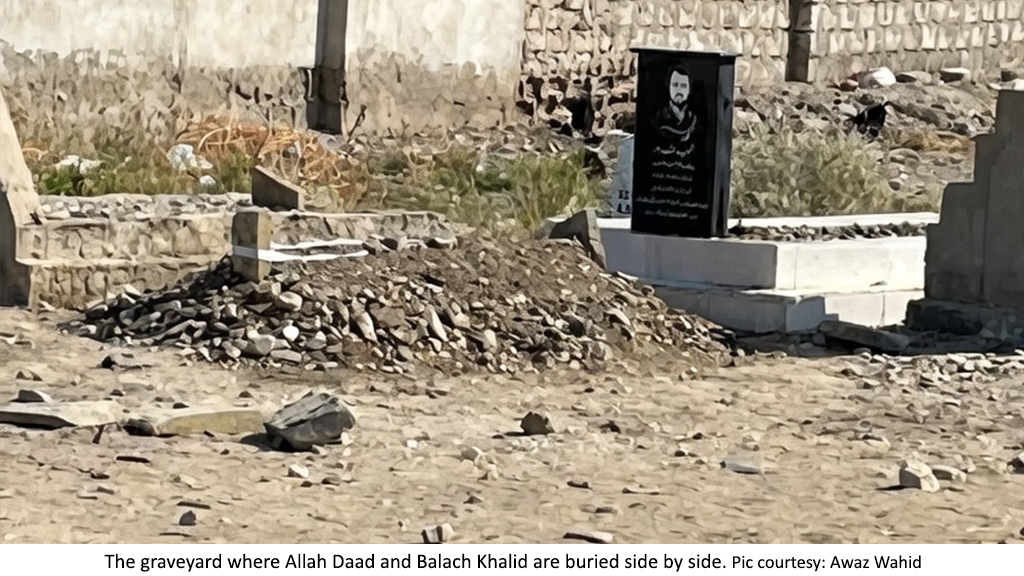
Four friends went to the cemetery. While they stood together at Allah Daad’s grave, two men on a motorcycle passed slowly, then turned around and came back. One of them raised a pistol. Two bullets. One struck Balach in the foot. The other entered his back. He succumbed to his injuries shortly after.
On the first anniversary of Allah Daad’s death, his friends buried another friend.
After Allah Daad was killed, I went to see Awaz.
In all the years I had known him, through cramped rooms, shared floors, the indignities of displacement, there had always been something warm between us. Even in the worst conditions, we found our way to each other. This time was different. Silence had moved in and taken up most of the space. I didn’t ask him how he was doing. I already knew, and I didn’t want to make him perform an answer. He was grieving. We sat. We said very little. The room held us both.
There is a logic to what is happening in Balochistan, and it is the logic of elimination.
You are an activist; you can be killed. You are not an activist; you can be killed. You speak about your rights; you can be killed. You stay silent; you can be killed. You study the wrong subject. You translate books into your mother tongue. You sit in a restaurant with friends. You stand at a grave and say I miss him. All of it. Any of it is enough.
What is happening in Balochistan is a systematic genocide. It moves slowly enough that the world can look away. It does not announce itself with the spectacle that demands attention. It arrives on motorcycles. It comes through phone calls in the night. It wears the uniform of counter-terrorism and the army.
Allah Daad believed the worst they could do was kill him. He was right about the worst. He was wrong to think that would be the end of it because the killing does not only take the person. It takes the translations left unfinished. The local remedies left undocumented. The brother in exile who carries a silence in him that not even Balochi, which he loved enough to give his life to, will be sufficient to hold.
The laugh that is no longer in any room.
(The name Nazir is a pseudonym used to protect the individual’s safety.)
