
Baloch Lives That Don’t Make Headlines
This January, at a workshop at the Centre for Excellence in Journalism [CEJ] at IBA Karachi, one of the instructors said, almost in passing: as journalists, we must bring the story, report it, without becoming emotionally involved. I sat there turning her words over in my mind. A question rose in me, one I did not dare ask then, but which stayed with me long after the session ended.
How does one report in the face of pain so raw, so personal, so crushing that it threatens to overtake your mind? How do you enter the home of a grieving mother who has just received the body of her son and not feel the full weight of that loss? How do you sit before her and keep your own heart from breaking alongside hers?
The mother knows, perhaps better than anyone, that your reporting will not bring her justice. Nor does she expect it to. The loss of a son is a wound that does not heal, a grief no words can ever close.
And yet she welcomes you into her home. She tells you what happened. She offers her grief, her memory, her story. She knows your writing may change nothing for her, and still, she speaks.
And somewhere in that exchange, something quietly shifts. She, the one carrying the unbearable, becomes the one consoling you, wiping away the tears you never meant to shed.
When the time comes to leave, she looks at you with tired eyes and says, “May your hands have more power.” You pause, unsure how to answer a blessing that lands like a wound. Perhaps she does not know the world of ink and paper you inhabit. What she sees is simpler than that: a pen in your hand, writing down what she says: her story, her son’s story, the loss she now has to live with.
But the question is not really whether journalism should be practised with attachment or detachment. The deeper question is whether journalists are truly reporting at all. Journalism, at its core, is meant to bring truth into view, to tell people’s stories as they are. But does that happen in Pakistan’s media institutions, especially when it comes to the Baloch in Balochistan and beyond?
Balochistan enters the headlines only when media institutions begin speaking in the language of the state. Their reporters are rarely on the ground, and when they are, they almost never report live. A statement is issued by a state spokesperson, and then it hardens into a headline. The truth, the voices of the people themselves disappear beneath the weight of an official narrative.
Take the case the media has repeated since March 2025: that the gate of the Civil Hospital mortuary in Quetta was broken, that the bodies of the “Jaffar Express attackers” were taken away by members of the Baloch Yakjehti Committee (BYC), and that BYC leaders were therefore arrested.
This is the version that has travelled across newsrooms. Again and again, the same backdrop is invoked: Dr. Mahrang and other BYC leaders were detained because they took away the bodies of militants.
But did any outlet bother to ask the BYC leaders, some of whom remain accessible, whether this is what actually happened? Did any reporter go to the ground, witness events as they unfolded, and verify the story for themselves? No. They did not. They do not.
Because in Pakistan, the media does not easily question the state’s version of events. And that is precisely how such violations continue. Perhaps this is simply how the machinery works. I can understand why many journalists do not report what they know, or do not do the work they are meant to do.
If a tweet by prominent lawyer Imaan Mazari, and even a retweet of it by her lawyer husband, Hadi Ali Chatha, can lead to a 17-year sentence, who in their right mind would risk openly challenging the state?
This is why I, as a Baloch, wake and sleep each day with images of the dead and the missing. They are not abstractions to me. They are people I know, people I adore. And yet in the media they remain nameless, faceless, reduced to absence. Human rights violations continue in Balochistan, and still they go largely unreported. The silence only deepens. It grows louder.
And then there is the guilt, the guilt that follows even writing. But the question is not whom to report and whom to leave out. It is not about one name or two. It is about the thousands, the countless faces that have slipped through the cracks for more than two decades.
How many deaths in a month? How many disappearances? How many among them are people we know? Each morning I wake with the same prayer: let there not be another devastating piece of news today. But there always is. Another body. Another face turned into a sticker on social media. That, too, has become routine.
And like that, on the morning of February 26, 2026, when I woke and reached for my phone, the first WhatsApp status I saw was from a friend from Buleda. I opened it. In a Balochi caption, she had written: “The tale of these pains cannot be written.” Above it was a picture of Nasram, with the words: “The bullet-riddled body of missing Nasram from Buleda has been found.”
I froze. I sat back down, then stood up again. My fingers trembled as I sent broken-heart emojis. She sent the same. What else could I do? I did not know Nasram personally, but I had often seen his family protesting in Turbat. This Ramadan, I had even planned to go there and report his story. But now he is gone.
And it brought me back to Nawab and Jangiyan from Panjgur. A friend would often post their pictures, and each time I would say: may they come home soon. Then, on the morning of February 14, 2026, he posted a picture of Nawab with a rose emoji. For a moment, I thought perhaps he had been released. I asked: has he been freed? He replied: yes, we have received his corpse. Just a day later, on February 15, Jangiyan’s body was found. Two friends, taken together, then laid to rest together. But it never became a headline. Not even once.
Time, and too much news like this, has left me struggling to find the thread of this story, unsure now where to begin. I was in Karachi when I first heard about Nasram’s custodial killing. I had already planned to go to Turbat. The next day, on February 27, I arrived there. And on the second day after my arrival, February 28, I went to the Aapsar area of Turbat to report on the case of the forcibly disappeared Jahanzaib Fazal.
When I reached his home, the women of the family were gathered beneath a chapra shade. The air was thick with a silence that felt heavier than silence should. I greeted them and sat down. Then, suddenly, I heard it: a collective cry, a wail rising from nearby. What is that? I wondered. Jahanzaib’s grandmother told me it was the family of Manzoor, their neighbour. The day before, she said, they had received his mutilated body, along with another.
Manzoor was only seventeen, she added, and his face was unrecognisable. Perhaps, she said, they had thrown him from the roadside down into Kech Kaor. One of his fingers had also been cut. At that very moment, she told me, Manzoor’s father had been at the Deputy Commissioner’s office in Kech, trying to secure his son’s safe release.
That image stayed with me. Baloch rights activist, Jamal Baloch had posted it: two bodies discarded among the bushes and stones of Kech Kaor, covered in thorns, their backs turned to the world.
I think I have to stop myself here. I’ve lost the thread again. But who wouldn’t? Since I’ve lost it, I’ll return to where I began, that is media, journalism, and Balochistan. Stories and reports from Balochistan are always welcomed, but only if they deal with the more “acceptable” issues: irregularities in fishing along its coast, the plight of fishermen, climate change, drought, ghost schools, hospitals.
These are undeniably important subjects, but they are also rarely written about, partly because much of Balochistan is so remote and getting there is often difficult, if not impossible. Still, at least these stories are granted a place in Pakistani media outlets. But the lives lost in Balochistan? There is no answer. No report. Nothing.
So I began my journey to Buleda. It was to be my third visit, and this time I was going for Nasram. I had already been there twice before to report two stories. One was about Nako Mayar’s son. Thank God, he had been released.
When I arrived, I also learned that Nako had migrated from Buleda to Paroom, in Panjgur. Perhaps grief and tragedy have their own kind of memory, one that burns deeply enough to force a person to leave a place behind. His family learned of his migration only when he returned one day to visit them and ask whether Nasram had been released.
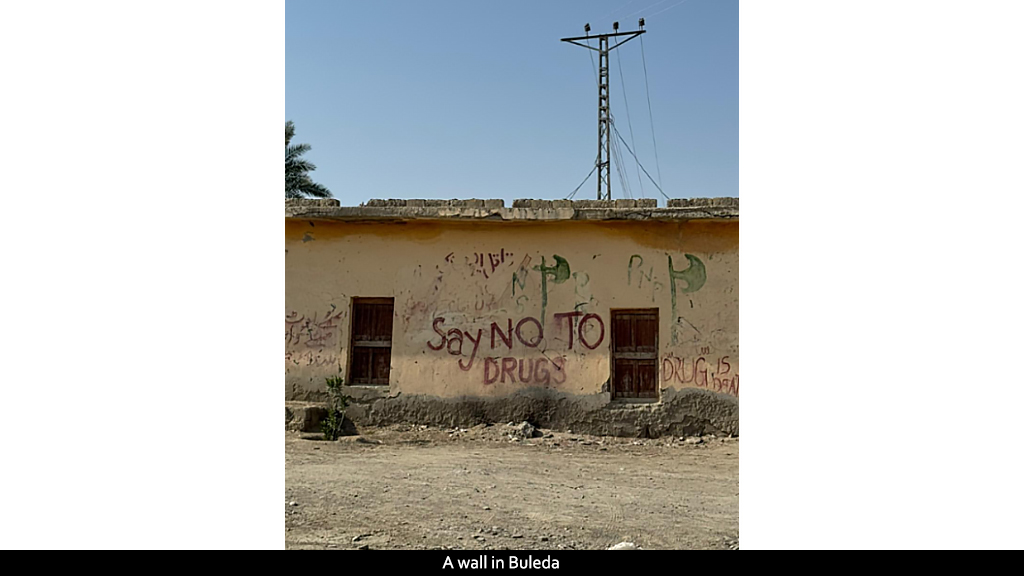
My third visit was on March 2, 2026. Finally, after years of waiting, the road connecting Turbat to Buleda had been built, after years of ‘corruption’. But Buleda itself remained unchanged. Once you arrived, the roads were still poor, and its walls still carried slogans like “Say No to Drugs,” while war, too, had left its own colour on Buleda’s muddy walls. The locals, when they see a new car, grow slightly uneasy.
I went there with three other friends. To be honest, writing Nasram’s story was not on my mind at that moment. We were going there to offer condolences, [furs] His death was too recent, and I knew how heavy it would be for his family, and for me to begin asking questions so soon after such fresh grief. But I carry a diary and a pen wherever I go, whether I plan to write or not. It is simply part of who I am.
When we entered the room, it was full of women, girls, and children. Among them, it was easy to tell who Nasram’s mother, Sahibatoon, was. Grief leaves its own mark on the faces of those forced to carry it. Around us, people were talking when my friend leaned close and whispered, “Hazaran, write his story.” I said, “No, I can’t.” She insisted: “No, this family is brave. If you ask, they will answer.” Still, I could not bring myself to begin.
And yet, when they themselves began speaking about Nasram, I asked quietly, “Can I write this down?” His mother said yes. I told her, “I’m sorry if, by writing this or asking these questions, I ‘ll cause you more pain.” She looked at me, her voice steady, and said, “No. I have promised my martyrs that I would not dishonor them by crying.”
She said martyrs, not martyr. The plural stopped me. My jaw dropped. In that one word was the weight of all she had lost.
I asked, “Nasram was released once, right? I had heard that. When was he forcibly disappeared again?” At once, the room filled with voices. Dates and events blurred into one another. I thought I would check social media later which is the only archive many Baloch families are left with to document their cases but before I could, Nasram’s sister stepped outside. Within minutes, she returned with a page in her hand, the dates written in broken Urdu. It contained everything: when Nasram was first taken, when he was released, and when he was disappeared again.
I took a picture of it. Nasram’s sister told me, “We kept this page with us. Whenever we went to a protest, especially for the media, we carried it.” Then they asked me to keep it, saying they no longer needed it. Those words ‘no longer needed it’ again broke my heart. I told her I had already taken a picture, and handed the page back.
Then Nasram’s mother began telling me what had happened. The first time they came for him, she said, it was around two in the night. “There were eight Frontier Corps [FC] vehicles.” Buleda has no electricity, so in summer people often sleep outside, under ‘bashana’ mosquito-net veils hung up for protection. She told me the FC arrived shouting, cursing, and above all abusing the women of the house. The words the family repeated to me were too brutal to put on paper. They were threats of rape and worse.
They tore down the bashana. Everyone woke in panic. The first thing they did was slap Peer Baksh, Nasram’s father. Nasram’s sister told me, “Seeing my father being slapped shook me to my core.” She was pregnant then. “I rushed towards the FC,” she said. “One of the soldiers pushed me, and I fell.” Standing beside her was their elder brother, Abdul Hameed, still alive then. His own death, too, would become part of this story. “They dragged him as well, slapped him, and took Nasram with them.”
October 12, 2023, that was the first time Nasram was forcibly disappeared. Before leaving, the FC threatened the family: they would return in two months, and they would not spare them. Nasram was still missing when they came back exactly two months later. Again, there were abuses. This time, they took the family’s mobile phones and two motorcycles.
After Nasram’s disappearance, the family did everything they could. They travelled to Turbat and protested for him. They sat at D Baloch in Turbat and blocked roads. During the 2024 elections, they were intimidated and harassed, but they stayed, insisting that their loved one be released. Other families from Buleda, and from Turbat as well, sat alongside them, demanding the safe return of those taken from them.
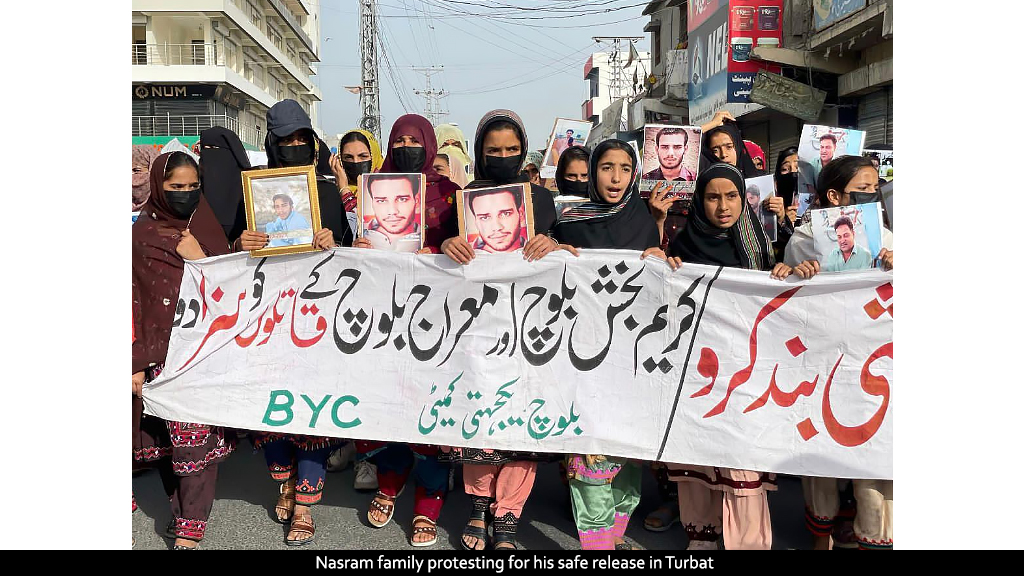
From June 2 to June 6, 2024, the family was part of a sit-in outside the Deputy Commissioner’s office in Turbat with other families from Buleda. A list of names was submitted to the DC, and they were assured that their loved ones would be released. Then, one day, a victim’s father from Buleda, who had been coordinating with the other families, told Nasram’s brother Abdul Hameed to come to Turbat. Known as Master Hameed, he was the principal of Sanj School in Buleda, a man deeply respected by his students and by the town itself. The DC, they were told, had said Nasram would be released.
Abdul Hameed went. He waited there for two days. No news came. On his way back to Buleda, at Buleda Cross, a white Corolla hit his motorcycle. He and his young son were killed on the spot.
The family believes the car belonged to state officials. They say Buleda Cross is not the kind of place where such an accident would ordinarily happen: the road is neither crowded nor particularly treacherous. They also say the driver of the Corolla tried to flee, but the car’s tyre became tangled with the motorcycle. By the time it was freed, people had gathered. He was arrested, they told me, only to be released again two months later.
As per Nasram family, he was released on June 13, 2024, three days after Master Hameed and his young son were killed.
The day he returned was also the third fatiha for his elder brother Hameed, who had gone to Turbat only to bring Nasram home, and had instead returned as a dead body. When Nasram arrived, he saw a ‘shamiyana’ [tent] with people gathered beneath it.
At first, he thought they had come to welcome him. But something in the air felt wrong, and he sensed it immediately. Because another of the brothers had joined the Baloch insurgency, Nasram himself had been forcibly disappeared as a form of collective punishment. At that moment, he feared that his insurgent brother had been killed in an encounter with the forces, and that this was why he had been released.
The family received him with tears and laughter tangled together. But Nasram, broken by imprisonment and torture, could not immediately understand what was happening. Only later, as night fell and he realized that Hameed was nowhere to be seen, then he learned that it was Hameed who had died.
The family told me they did not know how to hold that moment. Nasram was back alive, returned from a place they had believed he would never come back from. And yet Hameed, who had gone to bring him home, never returned alive. Nasram’s condition was critical, and he was taken to Karachi for treatment.
After returning from Karachi, Nasram became engaged to a cousin of his own choosing. His mother shared that, though he was a grown man, she still slept beside him under the same mosquito tent. After his release, she never let him out of her sight. Nasram, too, was living with deep trauma. He rarely stepped outside, always shadowed by the fear of what might happen again.
His sister said that Nasram had started working as a labourer behind his uncle’s house, just a minute’s walk away. By the time he was forcibly disappeared for the second time, he had earned 6,000 rupees, she told me that she still keeps this money with her.
The second time Nasram was forcibly disappeared, he did not return alive. He came home bullet-riddled and lifeless. His mother told me about the night he was forcibly disappeared again. It was August 8, 2024. That meant he had been free for only 55 days. In those 55 days, he did not get to marry, though he had wanted to. He did not get to live freely, though he had wanted that too. He lived those days in fear, in trauma, under the shadow of being taken again.
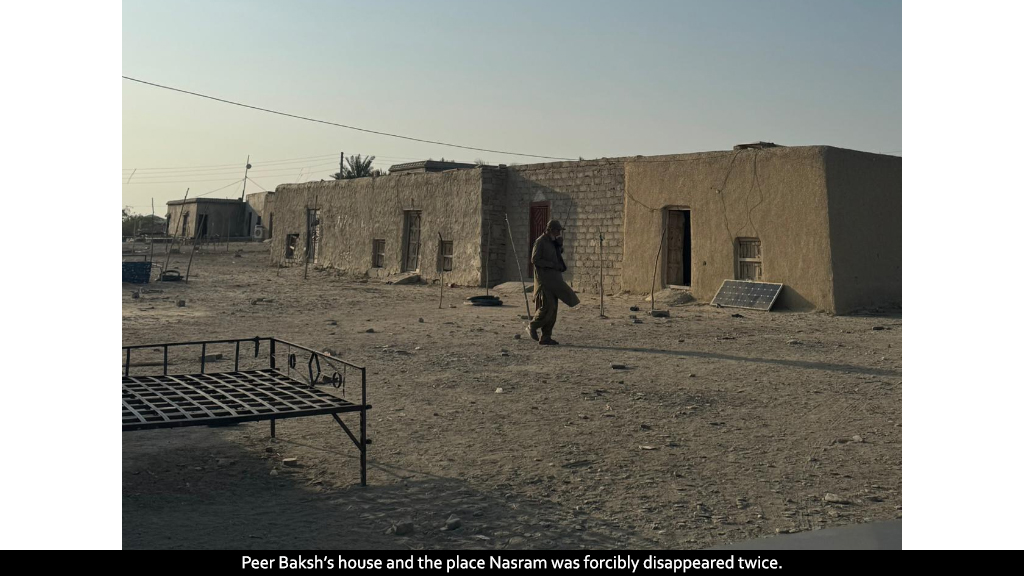
Nasram’s mother said they were sleeping outside when she heard footsteps. She stepped out from behind the bashana [the mosquito netting] and saw two men. They were speaking in Balochi and dressed in plain clothes, in shalwar kameez. “We are thirsty,” they told her. “We need water.” She said she gave them water. By then, Peer Baksh had also woken up. The men then asked for food, and Peer Baksh apologised, saying it was already four a.m., too late, and there was nothing left.
It was then, she said, that they asked where Nasram was sleeping. At that moment, she understood who they were: force personnel, back again for Nasram. “What do you want with Nasram?” she asked. By then, more men were approaching, all in civilian dress. They began pulling aside every bashana, searching for him.
When they finally found Nasram, his sisters threw themselves around him. “I pleaded with them,” his mother said. “You have only just returned him to us. It has only been a few weeks. Let him stay with us a little longer.” But the forces pulled Nasram’s three sisters away by their hair. Even as they resisted, they were dragged back until Nasram was forced into the vehicle.
His mother said the vehicle had been kept at a distance from the house so the family would hear nothing, so the forces, arriving in disguise, could take him silently. For more than fifteen minutes, she said, her daughters were dragged along as she ran after them. At the same time, Peer Baksh was beaten so badly that he could not get up and follow.
“Once they put Nasram in the vehicle, we ran after it,” she said. “The roads in Buleda are stony, unpaved. We kept running behind the vehicles for nearly an hour. They disappeared from sight very quickly, but still we kept following.”
Nasram’s sister shared that during his detention, the family received three messages from him through other enforcedly disappeared persons who were later released. The first was that he was alive and being held in Turbat, and that this time they had not tortured him much.
The second message came some months later. They were told that Nasram had said there was no case against him, that he was being held only because of his insurgent brother, and that they might release him.
The third message came, again, through someone who had been released. Nasram had said: tell my family to ask my fiancée and her family to wait for me. I will come back, and we will marry. Do not let them tie her knot with anyone else. At this, his sisters and everyone else in the house who had been holding themselves together while speaking about him broke down. And for a while, we all fell silent.
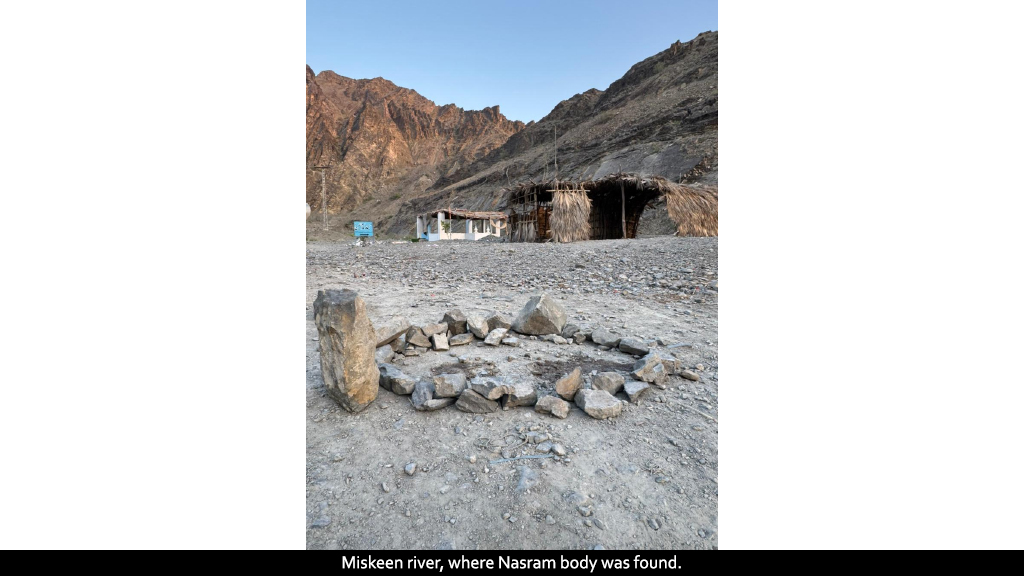
Then his mother broke that silence. The final message they received about Nasram, her 20-year-old son, she said, was that his body had been found by the roadside on the way to Buleda across Miskeen river, on 26 February 2026, after 1 year, 6 months, and 18 days of enforced disappearance.
She told me that there were bullet wounds on his chest, and marks of stamps on both his thumbs. “I don’t know,” she said, “whether they made him sign something before killing him, whether they told him he was being released, or something else.”
During his burial, his sister said, a drone hovered overhead. Even as people gathered for the funeral, the FC had surrounded the area. “We women thought they might threaten the men,” she said, “or disappear them too.” The force personnel told the women to go back. “You go back,” all of the women replied back. Nothing happened after that, she said, and in the presence of FC personnel and their own people, Nasram was finally laid to rest in his motherland.
I could not ask the family much more. I had no strength left in me to ask how they were living through all this: one son who had joined the insurgency long ago and would likely never return home, and two young sons and a little grandson, whose lives had been taken as collective punishment. What could a mother’s heart possibly hold after that? What question could fit there? So I stepped outside and prepared to leave for Turbat.
As we were saying our goodbyes, Nasram’s elderly father was standing there. When I greeted him, he laughed and told me that when the forces came for Nasram, he had tried to make them understand, and they slapped him for it. He laughed again. I asked him what he had said. He replied: “I told them, spare us. That son of ours left us long ago, and he will not return. Go and find him in the mountains and fight him, for we cannot find him. Nasram is innocent. We have nothing to do with our insurgent son’s actions.” For that, he said, forces beat him badly.
My head lowered. Then he said that “even if they bulldozed our whole family, that son would still not return. He has taken such a path, he said. Maybe his body will return one day or maybe not even that.”
Then I said goodbye, and we left for Turbat. On the way back, somewhere between Buleda’s mountains, across Miskeen river, we stopped by the roadside at the place the family had described, where Nasram’s body had been thrown, or perhaps where he had been gunned down. There is a small mosque there, a small hotel, and a chammag stream. The place now carries a mark: stones arranged in a circle where his body was found, placed there by his family. There were still traces of blood.
For now, I will stop here, though I know the story does not stop here.
