
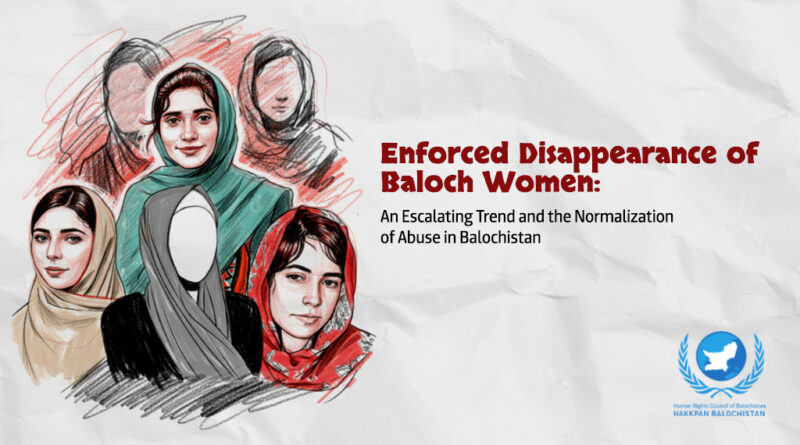
Enforced Disappearance of Baloch Women: An Escalating Trend and the Normalization of Abuse in Balochistan
The Human Rights Council of Balochistan expresses grave concern over the sharp and alarming surge in the enforced disappearance of Baloch women across Balochistan. Once considered an exceptional tactic, the abduction of women by Pakistani state forces has increasingly become a routine instrument of repression. This escalation must be understood within the broader context of mass enforced disappearances of Baloch men over the past two decades. Thousands of Baloch men, ranging from children and teenagers to elderly individuals, have been subjected to enforced disappearance or extrajudicial killing under the so-called “kill and dump” policy.
The Normalization of Abuse
For decades, enforced disappearances in Balochistan overwhelmingly targeted men, leaving women to bear the social, economic, and psychological consequences within their families and communities. In 2025, however, women themselves have increasingly become direct targets, marking a significant shift in the pattern of state repression.
As women assumed public roles as family providers and visible participants in peaceful resistance and rights-based advocacy, their prominence exposed them to retaliation. Enforced disappearance has thus been extended to women as a deliberate mechanism of punishment and intimidation, intended to suppress dissent, silence other women, and deepen collective suffering in a region already devastated by mass disappearances.
HRCB finds that the targeting of women is neither incidental nor isolated. It reflects a calculated effort to undermine women-led resistance by silencing activists and pressuring their families and communities. Raids are conducted openly, families are coerced into silence, and effective legal remedies remain largely inaccessible. The sustained absence of accountability has allowed these practices to become embedded in routine security operations, transforming the enforced disappearance of women from an exceptional abuse into a normalized instrument of state control.
Documented Cases (2025)
This report documents nine cases of enforced disappearance of Baloch women in 2025. These cases reveal a disturbing pattern of collective punishment and the systematic erosion of legal protections. Women from diverse backgrounds, including students, health workers, housewives, and human rights activists, have been abducted through house raids and late-night operations. Several victims were subjected to repeated disappearances and torture, while at least one case resulted in custodial death.
The involvement of state security agencies, including the Counter Terrorism Department (CTD), Frontier Corps (FC), and Military Intelligence (MI), underscores the institutional nature of these violations.
- Gulzadi (Human Rights Activist) – Mach / Quetta
Gulzadi, daughter of Nabi Dad Satakzai, is a Baloch human rights activist from Mach, Bolan. On 7 April 2025, she was abducted by the CTD during a house raid on Brewery Road, Quetta, in the presence of her family. This was not an isolated incident: Gulzadi was first abducted on 12 March 2025 and later released. On 24 March, her home was raided again, belongings looted, and personal items desecrated. Her April abduction marks the third act of persecution within a single year.
Following her abduction, she was transferred to jail under the draconian Maintenance of Public Order (3-MPO), illustrating the use of preventive detention laws to legitimize enforced disappearance. She was later nominated in 16 different criminal cases. Although she was granted bail in rest of these cases, she remains imprisoned in three others.
Throughout this process, the state has demonstrated a clear disregard for constitutional guarantees. Ordinary cases have been turned into anti-terrorism charges, and two separate FIRs have been filed for the same incident with different charges. This blatant disregard for legal norms reflects the state’s intention to prolong her incarceration while systematically denying her the right to a fair trial.
- Mahjabeen Baloch (Student) – Besima / Quetta
Mahjabeen, 24, daughter of Ghulam Mustafa and a BS Library Science student at the University of Balochistan, was forcibly disappeared on 29 May 2025 at approximately 3:00 AM. Personnel from CTD and Military Intelligence abducted her from the Civil Hospital Hostel in Quetta. Her disappearance highlights the targeting of educated Baloch women and the violation of protected civilian spaces such as hostels and hospitals. As of the end of 2025, her whereabouts remain unknown.
- Robina Baloch (Health Worker) – Kech
On 30 June 2025, Robina Baloch, a government Lady Health Visitor (LHV) from Gwarkop, Kech, was abducted from Overseas Colony, Turbat, by Frontier Corps and Military Intelligence personnel. Her home was violently ransacked during the raid. Robina was later released without explanation.
- Safia Bibi – Khuzdar (Zehri)
Safia Bibi was detained on 5 October 2025 during a large-scale military operation in Norgama, Zehri, Khuzdar district. Pakistani forces imposed a curfew, sealed the area, and conducted mass house raids. Safia and three men were taken to an undisclosed location. Although later released, her detention occurred in a context of collective punishment, where entire communities were placed under siege.
5-6. Nazia Shafi and Pari Baloch – Panjgur (Custodial Death)
The case of Nazia Shafi represents one of the most horrific examples of state violence against women in Balochistan. On the night of 28 October 2025, Frontier Corps personnel and armed collaborators raided her home in Panjgur and abducted Nazia and her mother, Pari Baloch at gunpoint. On 29 October, Nazia was found dumped near Civil Hospital Panjgur in critical condition. She died from her injuries while being transferred for treatment. Her mother was later released with visible signs of torture. Nazia’s death constitutes custodial killing following enforced disappearance.
- Nasreen– Awaran / Hub
Nasreen, a 15-year-old girl from Teertaj, Awaran, was abducted on 22 November 2025 around midnight near Daro Hotel, Hub Chowki. CTD and Military Intelligence personnel carried out the abduction. She remains missing.
- Farzana Zehri – Khuzdar
Farzana Zehri was forcibly disappeared on 1 December 2025 while returning home from a hospital in Khuzdar. Security forces detained her, and her whereabouts remain unknown. Her abduction in a public setting further demonstrates the brazenness with which enforced disappearances are carried out.
- Rahima (Housewife) – Chagai
On 9 December 2025, Rahima, 20, a housewife from Zahoor Colony, Dalbandin, was abducted during a late-night raid by CTD. Her 18-year-old brother was also taken and remains missing.
Legal Framework and Violation
These acts violate Pakistan’s Constitution (Articles 9, 10, 14), international human rights law, including the ICCPR, CEDAW, CRC, and the prohibition of enforced disappearance under customary international law. The failure to criminalize enforced disappearance and hold perpetrators accountable perpetuates impunity and entrenches a culture of state-sanctioned abuse.
