
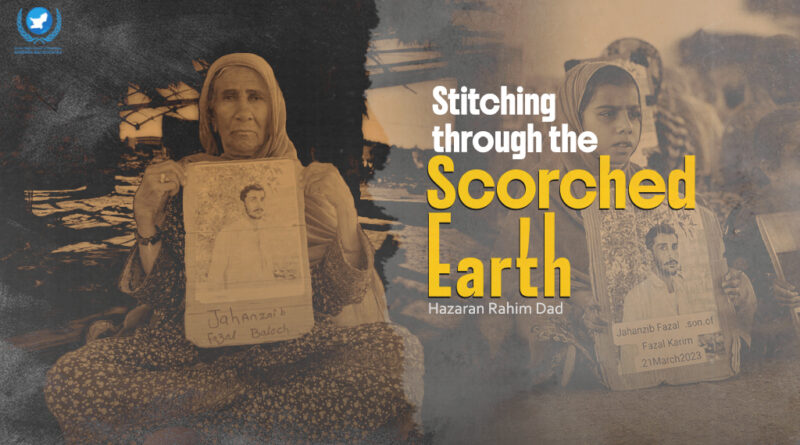
Stitching Through the Scorched Earth
In the holy month of Ramzan in 2026, Nasreen sits beneath a chapra — a makeshift shelter of wood and thatch — a short distance from her room in Turbat, in Kech district of Balochistan, Pakistan’s insurgency-scarred southwestern province. Around her, her only two daughters, her mother and other women in the family bend over pieces of cloth, their hands busy with intricate Balochi embroidery.
There is no electricity. The room behind her is hot and airless, so they work outside in the shade, though even here the heat bears down. She apologises for making a guest sit outdoors and urges me to move inside, but I tell her I am fine where I am. Nasreen looks up only briefly, pausing just long enough for the needle to hover above the fabric before lowering her eyes again. She says she cannot afford to stop. An order must be finished before Eid; the client is waiting, and there is no time to lose. This is how the household survives: through the embroidery she sews, stitch by stitch.
Inside the sweltering room sits her husband, Fazal, known locally as Fazal “Shikari”. Once a driver, he says he could no longer continue working; the strain had drained what strength he had left. Beside him sits his 11-year-old son, now his only remaining son, watching with curious eyes as his father begins to speak.
Fazal says his son, Karim Jan, was forcibly disappeared by Pakistani forces on May 23, 2022, and released on Aug. 17, 2022. After his return, the family tried to resume life. But one morning, they woke to find him gone. He had left behind a message saying he would not return. Later, the family learned that he had joined the Baloch insurgency.
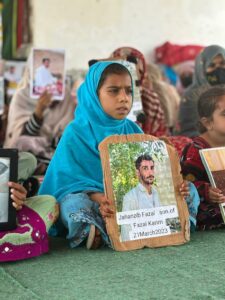
Shikari says that when Karim Jan left for the “Koh” — the mountains, as many Baloch describe those who join the insurgency — another blow soon followed. His other son, Jahanzaib, a second-year FSc student at Atta Shad Degree College in Turbat, was forcibly disappeared by Pakistan’s paramilitary Frontier Corps (FC) on March 21, 2023. He was taken from the shop where he worked in Turbat’s Apsar Bazaar, not far from the family home. It was around sunset, Shikari recalls, and many locals saw what happened. Jahanzaib was blindfolded inside the shop, he says, then kicked “like a football” before being thrown into an FC vehicle. Later, a witness who was also their neighbor ran to the family’s house with the news that Jahanzaib had been taken by the FC.
After that, Shikari says, word reached him through different sources, which he does not name, perhaps for security reasons. The message was always the same: If he called his insurgent son back, Jahanzaib would be released. But that, Shikari replied, was no longer in his hands.
He recalls one such encounter with the Deputy Commissioner (DC) of Turbat, to whom he had turned in the hope of securing Jahanzaib’s release. The official, Shikari says, asked about his other son’s involvement in the separatist movement. Shikari remembers answering with the desperation of a father who had run out of ways to plead: “The son who left for the Koh is gone. You and I both know he will not return. If you want, hang me publicly at Shaheed Fida Chowk. If you want to shoot me, just tell me where to come and I will be there. Do what you want. Empty your bullets into my body — just bring Jahanzaib back. My son is dearer to me than my own life’
He stops there. For a while, the room goes quiet. I do not interrupt. When he speaks again, it is to say that Karim Jan never contacted the family. The next time Shikari heard of him was after his death — news he came across on social media, and which he describes as his son’s “martyrdom.” that his son had become part of the Baloch Liberation Army’s (BLA) suicide unit, the Majeed Brigade, and had taken part in an attack on the headquarters of state agencies in Gwadar on March 20, 2024.
Struggle for Jahanzaib Release:
The family continued the struggle to secure Jahanzaib’s release. Shikari says that in June 2024, he joined other families of the disappeared in a sit-in outside Turbat’s deputy commissioner office . Families had come from across the district, demanding the return of their loved ones. For weeks, they remained there in punishing heat. The DC, he says, kept urging them to call off the protest, assuring them that their loved ones would be released. But the families had heard such promises before, and none had led anywhere. By then, the scorching weather and the strain of a sit-in that had stretched beyond a month had worn many of them down. Some were ready to end it. Shikari was not.
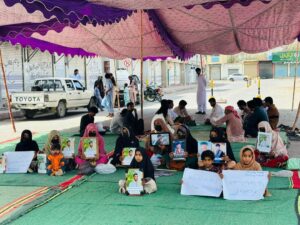
He says the DC eventually called him into his office and accused his family of being “terrorists” and of keeping weapons in their home because of his another son’s affiliation with BLA — even though that son was already dead by then. Shikari says he replied that the official was free to search his house “inch by inch” and would find nothing. Jahanzaib, he insisted, was innocent — punished, in his view, for the actions of his brother, who was no more. Then, Shikari recalls, he told the DC: “Let me place the Quran on my head and swear there are no weapons in my house. You place the Quran on your head and say there are.”
The DC, Shikari says, had no reply. He adds that Sibghatullah — better known among Baloch as Shajee, a central leader of the Baloch Yakjehti Committee (BYC) who was with him at the time and who would later be detained in March 2025 for speaking out against enforced disappearances and other human rights violations in the region — also spoke up, telling the official to have some shame and to pray that such a fire never reached his own home. “They are cruel, very cruel,” Shikari says. “Nothing works on them.”
Nasreen shared that they protested again and again for Jahanzaib’s return, enduring one ordeal after another. One of those protests took place during Pakistan’s January 2024 elections, at D Baloch in Turbat, where families of the forcibly disappeared blocked the main road into the city and nearby areas. She remembers one night in particular, when rain came down hard and the tent over their heads collapsed. They asked the police stationed across D Baloch’s check post to let the children shelter there for a while, she says, but the officers refused, saying they needed permission from the DC. The reply that came back, she says, was blunt: Call off the sit-in. The families refused. So they stayed through the night in the rain. Women held the tent up with their hands; the children were shielded beneath it. “We trembled like leaves on a tree,” Nasreen says with a faint smile, before quickly wiping away the tears that gather in her eyes. “But even that was nothing compared with the torture our missing persons may be facing in the dungeons.”
She says that in June 2024, the family joined another weeks-long sit-in outside the DC office in Turbat, one of the hottest places in Balochistan in summer. The heat was so intense, she says, that the road beneath them seemed to burn their feet and skin. “In that weather, even birds would fall from the sky,” she says. Yet they remained there — women, children, entire families — despite rashes, skin infections and the exhaustion that settled into their bodies. Some of the disappeared were eventually released, she says. Jahanzaib was not.
A Mother’s Heart in the Time of “Kill and Dump”
“So much kill-and-dump has happened that we have lost our hearts,” Nasreen says. Her eyes remain fixed on the cloth in her lap as the needle slips in and out of the fabric. Almost every day, she says, there is news of the bodies of disappeared people being found. Each report lands on the family like another blow. With Jahanzaib still missing, the fear has become a permanent weight.
Nasreen says she still prays for mercy. “May Allah put mercy in the hearts of the foji,” (forces) and make their hearts soft as wax, and may they release my son.” Day and night, she says, she moves between hope and dread. One moment, she believes Jahanzaib will walk back through the door; the next, her heart sinks again. Too many bodies have turned up for her to trust hope for long. “We do not know how Ramzan comes and goes, how Eid comes and goes,” she says. “I am grieving not one son, but two. Of one, I know he will never return. Of the other, I do not even know his fate. Only a mother’s heart knows this pain.”
She said that whenever she attends the funeral of another mother’s son, “I congratulate the mother upon receiving his mutilated body; at least she has something to bury. Since I know what became of Karim Jan, but Jahanzaib…” She paused, grief catching in her throat. “What could be more terrible than not knowing? I do not even know whether he still exists.”
At this, her own mother — Jahanzaib’s grandmother — leans in. The young, she says, are being wiped out: disappeared, killed, or driven to the mountains. The uncertainty has entered ordinary life. These days, she says, if someone leaves for the bazaar, the shop or even a small errand and returns later than expected, fear begins to gather before they make it home. No one knows when the forces might come and take someone away.
Nasreen says her husband barely steps outside now. The only place he used to go was the deputy commissioner’s office, and even that, she says, ended in disappointment. In December 2025, she and her husband went there again. This time, she says, she spread her Chadar [scarf] before the DC in supplication, begging him to help secure Jahanzaib’s release. But the official told them the matter was no longer in his hands, that he was helpless now. Since then, she says, her husband has withdrawn almost completely.
“How can our helplessness not become a curse on them?” she says, recalling how officials had repeatedly urged families to end their protests with promises that their sons would be released. She remembers one phrase in particular, spoken by the DC: “Shome dua, mani juhd” — “your prayers and my struggle.” Now, she says, even he claims to be helpless.
In a House of Loss and Waiting
Nasreen’s mother — Jahanzaib and Karim Jan’s grandmother, whom everyone calls Balli — seems torn between two griefs: the certainty of one loss and the uncertainty of the other. “They were so young,” she says. “So young. They had not yet even grown their moustaches and beards. They had not yet become men.” Her voice trails off, then gathers force again. “I do not see them now. I do not see them. The government has turned our lives into hell.”
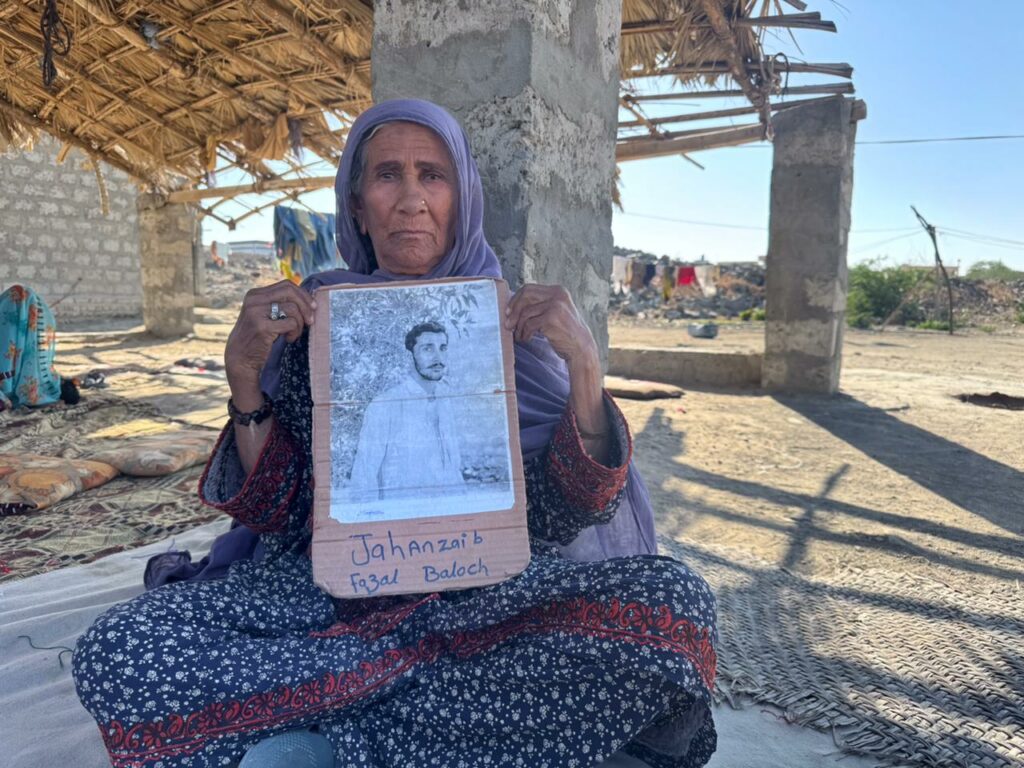
Both boys, she says, once shared a room with her. At night, she would fall asleep to the sound of their laughter. Only the family, she says, knows how hard life was and how with terrible hardship these children were raised. “You can live on a single piece of bread,” she says. “Poverty does not kill you. What kills you is this grief — when your children are no longer around you, and you do not know why they must suffer like this.”
She says that when Karim Jan was released after three months, he was no longer the same. He insisted little had happened to him in custody, but his family could see what had been done to him. At night, when she spread out his waabjaah — the bedding he slept on — he would begin to speak. “Balli, they are animals,” he would say. Then he would correct himself: “No, Balli, they are worse than animals. They hate us. They hate all of us. They will devour all of us.” She says he repeated such things night after night, and she would try to calm him. “Abbali, my son, don’t say that. Go to sleep. Forget it.” But he never seemed able to forget.
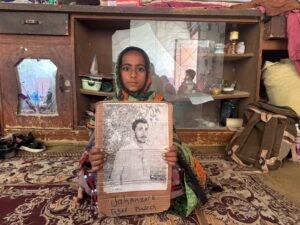
His grandmother also recalled that in the middle of the night, he would wake screaming, “Hold me, mother—they are taking me again to torture me. Hold me, hold me in your arms.” On summer nights, she said, neighbours sleeping outside their homes would hear his cries and rush over.
Then she turns to Jahanzaib. After Karim Jan left for koh, she says, Jahanzaib became the eldest son at home, the one who looked after everyone. In Turbat’s brutal summers, he would sprinkle water on her clothes and chadar so she might feel a little relief from the heat. The bedding she once laid out for the boys, she says, Jahanzaib later laid out for her. If the electricity went out, he would hurry to find a torch because he knew she feared the dark and might fall. “He never let me remain in darkness,” she says. “Now look at the darkness in this house. I see no light.”
On the day he was taken, she recalls, Jahanzaib had a fever and the flu. He had already missed college. She says she told him to skip his shift at the shop too, to stay home and rest. But he refused. He did not want to anger the shop owner by taking leave.
Nasreen says the moment she heard that Jahanzaib had been picked up by Fojis,her world stopped. “Everything ended for me that day,” she says. She remembers nothing of what followed. When she opened her eyes, she was in a hospital bed. No one told her exactly how she had reacted; she herself had not been conscious enough to know. Since then, she says, she has gone on living only in the bare, mechanical sense — the way people do when days must still be endured. “I stitch clothes, I keep the house going, I bear the pain in my back, and I do not complain,” she says. “We know how we raise these children. Then they come and disappear them like they are some toys and not human.
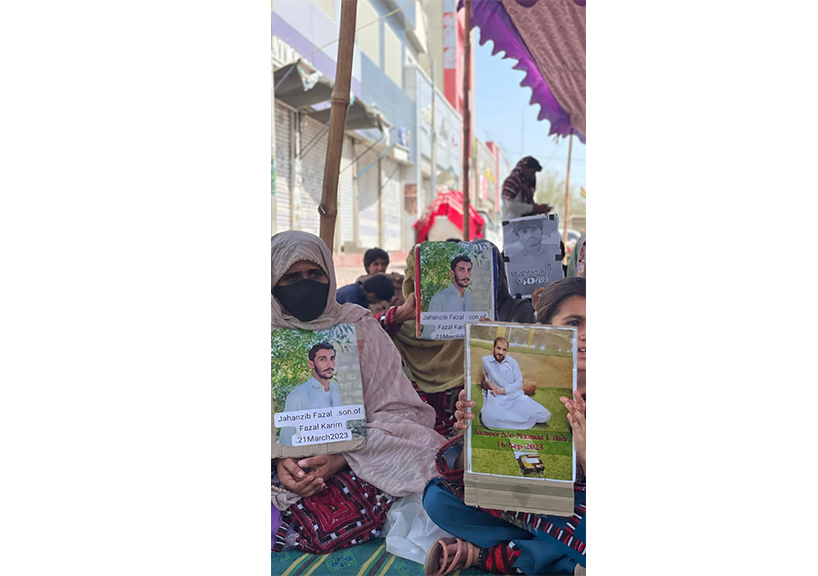
There is no Eid in the house anymore, Balli says. It is not that they cannot afford new clothes; they can. But happiness, she says, does not come from cloth. It comes from a heart at ease, and theirs are not. At iftar, she turns her eyes away from Nasreen and Fazal as they break their fast. She has no heart for it, she says, so she breaks her fast alone.
Now, she says, her heart has become mad with longing for Jahanzaib. A fire burns inside it, one that not even an ocean could quench. One grandson, she knows, will never return. The other, she says, still must. “They should release him,” she says. “They should let him come home.”
This piece ends here, but I am still haunted by the eyes of Fazal’s 11-year-old son, who listened to it all in silence, and whose name I forgot to ask.
