
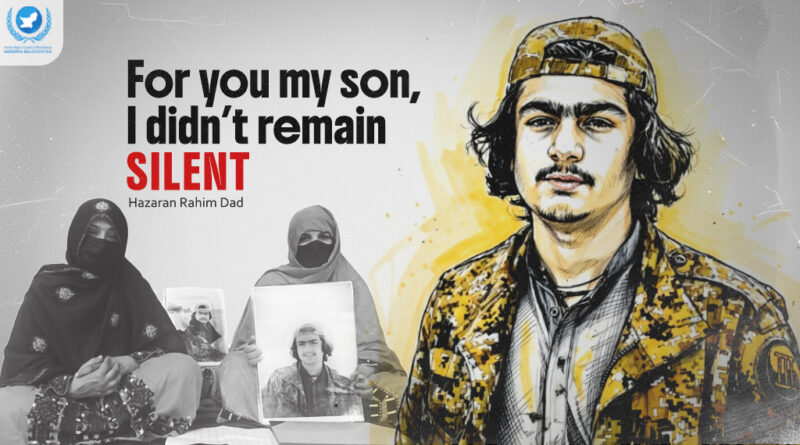
For You My Son, I Didn’t Remain Silent
Shortly after 9 p.m. on June 3, 2025, a phone call reached the home of Arifa Shah in Mastung, a city in Pakistan’s southwestern province of Balochistan. Arifa’s husband, Syed Manzoor Shah, answered. The caller did not identify himself. He said only that their eldest son, Ehsan, had been involved in an accident and that he was calling from a medical emergency team stationed near Lakpass, a mountain pass across the city.
Manzoor left immediately. For several hours, Arifa tried calling him. He did not answer. When he returned, close to midnight, his chadar was damp with tears. He avoided her eyes.
“Where is Ehsan?” she asked. “Is he all right?” Manzoor nodded and told her not to worry.
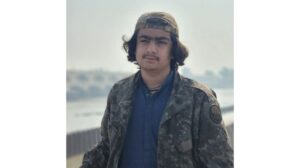
Minutes later, Ehsan was carried into the house, wrapped in a blood-soaked cloth. His body was motionless. Arifa rushed toward him, demanding to know why he had been brought home instead of to a hospital and why her husband had said he was fine.
She checked for his breath. Then for a pulse. There was none. A bandage had been tightly wrapped around his neck. Ehsan’s body was taken to Gous Baksh Hospital in Mastung for a medical examination. When doctors removed the bandage, the family saw a gunshot wound.
Only then did Arifa learn what her husband had discovered earlier that night at Lakpass: Ehsan had not been in an accident. He had been gunned down by Pakistan’s paramilitary force, the Frontier Corps (FC), according to the family.
That night, Arifa sat beside her son’s body, unable to look away. “I did not raise him for bullets,” she said.
She wanted to protest — to take her son’s body into the roads and demand justice. Her husband refused. He told her they should not subject their son’s body to further harm by seeking justice from the very system that had killed him.
“If they [forces] could kill him so easily,” he said, “nothing will happen to them.”
No Ambulance, No Case
Ehsan’s body was brought home in the back of a local pickup truck, not an ambulance. Arifa said the FC did not allow an ambulance to transport him. She later learned, that members of a medical emergency team had arrived with an ambulance but were stopped and turned back.
The motorcycle Ehsan had been riding remained at the site of the shooting. That same night, Arifa said, her husband tried to retrieve it, but FC personnel prevented him from doing so. Three days later, he returned and was finally allowed to take it.
During those three days, no police case was registered. When Manzoor was eventually permitted to collect the motorcycle, he did not take it home. Instead, Arifa said, he went directly to the Mastung police station and asked to file a first information report (FIR), against the Frontier Corps.
The station house officer (SHO) laughed. “Have you lost your senses?” Arifa recalled him saying. “How can we register an FIR against the Frontier Corps?”
Another officer warned Manzoor to consider his remaining sons. Filing a case against state forces, he said, could put them at risk and could cost Manzoor his own job, since he serves as a Levies constable.
Still hoping for intervention or unwilling to return home without having tried — Manzoor went to the office of the deputy commissioner (DC) in Mastung. There, Arifa said, he was scolded.
“One son is already gone,” the official told him. “Do you want to lose the others too?”
A Court Order, Ignored
Ten days after Ehsan’s killing, Arifa went to the Mastung police station herself. She was turned away again. She then went to the Mastung sessions court and filed a petition. Seven days later, an additional sessions judge issued an order directing the police to register the FIR.
Arifa returned to the police station with the court order in hand. She was told the SHO was not present and that the FIR would be registered once he returned. She refused to leave.
She arrived around 3 p.m. and waited until nearly 9 p.m. When the officer finally appeared, he told her to return the next day. It was after working hours, he said, and he was leaving to attend a wedding.
The following morning, Arifa said, she contacted him again. He assured her that he was writing the report and told her to come to the station once it was completed. She said it was an excuse. He did not contact her for the rest of the day.
When she returned the next day, she was told the officer was away on official business. Arifa then held a press conference at Mastung press club, the recorded video of the presser was shared on social media and it spread quickly.
Soon afterward, she said, the FIR against FC appeared in several local WhatsApp groups. The police never handed her a copy, but Arifa believes the public attention forced its registration.
Pressure to Withdraw
Days passed after the FIR was registered, and nothing followed.
When Arifa returned to the police commissioner station to ask what and when action would be taken, the SHO told her that the DC had instructed him not to proceed. According to Arifa, the officer said he had been ordered to tear up the FIR and discard it. He showed her text messages, she said, in which the DC warned that he [SHO] would lose his job if he pursued the case.
Arifa then began going to the DC office herself. Each time, she said, she was made to wait for hours, sometimes until nightfall. The DC would not return to his office, and she would eventually be forced to go home.
She said this continued for nearly a month and when she returned to the Mastung sessions court, Arifa learned that both the DC and the SHO had gone to the High Court in Quetta to seek the cancellation of the FIR.
A few days later, Arifa said, the DC sent an intermediary.
Faiz Durrani, an administrator with a local media outlet, Voice of Mastung, told her that the DC wanted her to withdraw the FIR. If she agreed, he said, the authorities were willing to meet her according to local Baloch customs — to sit together and address her grievance without court proceedings.
Arifa rejected the proposal. “Tell the deputy commissioner to bring me my son’s killer,” she told Durrani. “I don’t need anything else.”
According to Arifa, Durrani later returned with another message: she could name any amount as compensation. “Bring the forces who killed my son,” she said. “I want to ask [Forces] why they killed my son.”
Arifa claimed that Durrani then offered five million rupees [50 lacs] on behalf of the DC. Arifa refused.
After she rejected the offer, Arifa said, Faisal Manan, the chairman of the municipal committee in Mastung, approached her at the sessions court. He told her that the deputy commissioner wanted her to bring her two younger sons. A written agreement could be arranged, he said, guaranteeing government jobs for them once they turned 18 and for Arifa as well.
Her lawyer urged her to consider the proposal. She went home instead. “I cannot shame Ehsan by selling his blood,” she said.
The meeting with Manan took place about two months after Ehsan’s killing, Arifa said. By then, she added, she was determined to continue the case. According to her, Manan told her that the authorities acknowledged the Frontier Corps had made a mistake but wanted to resolve the matter quietly. He urged her to think about the future of her remaining sons.
“I told them no,” Arifa said. “Not on their brother’s blood.”
After Ehsan’s killing, Arifa said, and after she refused to remain silent, surveillance drones were flown over her home. When she stepped outside, she said, unfamiliar cars parked nearby and followed her movements.
Blocked, Threatened, Undeterred
More than two months after Ehsan’s killing, Arifa traveled to Quetta with her nine years old daughter, hoping to meet the DIG of police. She was unable to secure a meeting. Instead, a SHO asked why she had brought her daughter with her.
“If that had happened to your son, what would you do?” Arifa asked him in return.
The SHO told her, “If ten of my sons were killed, I still would not have brought my daughter.” He warned her it was dangerous and told her to return home.
Undeterred, Arifa wrote letters to the DIG and later to the chief minister. At the CM house, she was turned away and denied a meeting.
She then held a press conference at the Quetta Press Club. When that ended, she began a sit-in outside the building that would last fourteen days. On the first day, the DSP arrived and asked her to end the protest. She refused.
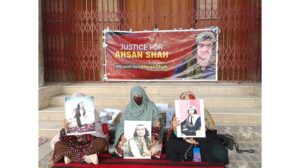
On the eleventh day, the assistant commissioner (AC) came and invited her to his office, promising to call the Mastung deputy commissioner to join the discussion.
“I have spoken to the Mastung DC many times,” Arifa told him. “Nothing has happened. There is nothing to discuss in a closed office. Bring the Mastung DC here, and we will talk.”
The AC refused. Over the following days, police repeatedly demanded she leave. When she ignored their orders, officers removed her carpet, a water cooler, and other belongings. She continued to sit on the bare street. On the twelfth and thirteenth days, police warned nearby shopkeepers not to cooperate or sell anything to her.
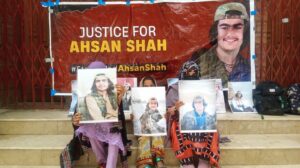
On the fourteenth day, police attempted to arrest her. The operation was led by a SHO in plain clothes, accompanied by other officers also in civilian dress. They ordered her to end the camp. She refused to leave. One officer slapped her daughter, knocking her to the ground.
“I remained silent,” Arifa said. “I told them I will not end the protest camp. It is my right, and my demands are legal.”
A female constable tried to pull her daughter from her lap. The child screamed and lost consciousness. Arifa herself was grabbed by police and nearly forced into a vehicle. Bystanders intervened, and she was released. She ran to her daughter, stopped a rickshaw, and took her to a hospital. Arifa said police ensured no one recorded the incident.
When her daughter received treatment, Arifa returned that night to Mastung after police repression. “At least whatever happened,” she said, “I was able to save my daughter from these brutes.”
Threatened, Targeted, Trapped: Life Under the Frontier Corps
On the day of the shooting, Arifa said, Ehsan was not alone. He was riding his motorcycle with a friend, Shoaib, when bullets struck them. Shoaib was hit in the right eye, leaving it completely damaged, and was admitted to the Quetta Trauma Center for more than ten days.
Shoaib later admitted that both he and Ehsan had been shot by the Frontier Corps. But when he was summoned as a witness in court, he said he had been warned not to speak and did not identify the shooters. In court, he testified only that he had been shot in the eye and had not seen who fired.
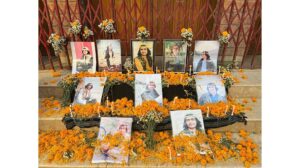
Ehsan’s case remains under hearing at the Mastung sessions court. With no witnesses willing to speak, the proceedings continue to stall.
According to Arifa, Ehsan was a lively, adventurous child. He loved photography and frequently went on picnics to the hills and valleys of Mastung.
Months before his killing, Arifa said, he had been called by an unknown person to visit a military camp, often receiving calls around 1 a.m. She told him she would protest if he went, but he insisted: “Mother, when they come to pick me up, they will come here. It’s more dangerous. I will go myself.”
When Ehsan visited the camp, she pointed out that he was told that the authorities were aware of his adventures and only wanted him to report any sightings of sarmachar (a Balochi word for Baloch armed groups) to the Forces. He declined and returned home. After that, she said, Ehsan began receiving threatening calls.
He told his mother that one caller had demanded he work for them or be killed and falsely presented as a member of the Baloch Liberation Army (BLA). On the day he was killed, Arifa said, Ehsan and Shoaib were traveling to Quetta for Eid shopping when the FC blocked the road at Lakpass — an ambush, she said, deliberately aimed at Ehsan.
A Mother Who Would Not Be Silent
The day Arifa received her son’s body, there was no time to mourn. Instead, she chose to fight. When she saw the wound: the bullet that had pierced his jaw and neck — she resolved that Ehsan would not be buried in silence. She decided on the spot to protest. Her husband and close relatives urged caution, warning her that a system that had killed her son would never deliver justice. But Arifa could not remain still.
From the third day after Ehsan’s killing, she did not sit at home. She moved between police stations, to press clubs, and every legal authority she could approach. Each time, she encountered only disappointment. Still, she attended court, appeared at hearings, and marked every date.
She has two younger sons, aged 11 and 13, and a daughter. She described Ehsan as the happiness and light of their home — full of dreams and life, in love with the mountains of his land, often wandering to savor their beauty. “After him, our home feels abandoned,” she said.
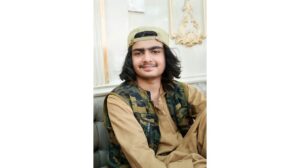
“I know Pakistan will not give me justice,” she added, “but how could I satisfy a mother’s heart that embraced her young son’s bullet-riddled body? I still appear before courts, police stations, and deputy commissioners, seeking action, but nothing happens. At least the day I reunite with my son, I can tell him proudly: for you, my son, I did not remain silent. I fought for you with whatever will was left in me.”
Her daughter once said, “At least they should have left my brother until Eid. He should have celebrated Eid with us.” Ehsan was killed four days before the festival. Arifa shared that her younger sons now harbor deep anger toward the government and the Frontier Corps. “They don’t even go to school,” she said. “They say, ‘Mother, you will weep all day.’ I force them to go, and when they return and see my condition, they refuse the next day.”
“Our whole life has been turned upside down,” Arifa said.
