
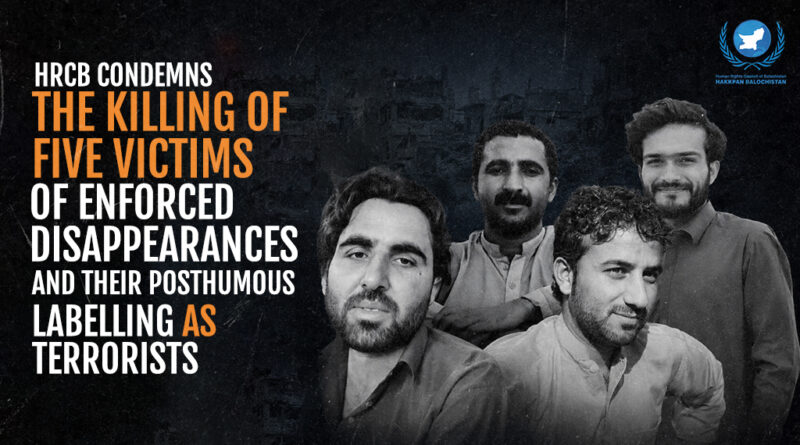
HRCB Condemns the Killing of Five Victims of Enforced Disappearance and Their Posthumous Labelling as Terrorists
The Human Rights Council of Balochistan (HRCB) strongly condemns the extrajudicial execution of five victims of enforced disappearance who had remained in the custody of security forces for months before their bodies were recovered following the attack on the Coast Guard camp in Jiwani. The subsequent attempt to portray the victims as terrorists appears to be part of a recurring pattern of justifying the unlawful killing of persons previously subjected to enforced disappearance.
The victims have been identified as:
- Muhammad Abdul Haq, son of Muhammad Murad, a school teacher;
- Chakar Ghulab, a shopkeeper;
- Peeri Essa, a fisherman;
- Shah Bakhsh Umar, a fisherman; and
- Haider Ali.
None of the victims had been produced before a court of law, formally charged with any offence, or afforded the constitutional guarantees of due process and a fair trial.
Muhammad Abdul Haq
Muhammad Abdul Haq was an educator who operated a school in Gwadar. He was forcibly disappeared from his home during a security raid on 24 January 2026, after which his whereabouts remained unknown.
His case reflects the prolonged pattern of persecution faced by his family. His elder brother, Muhammad Ramzan, a political activist, was forcibly disappeared in July 2010 from the Makran Coastal Highway and remains missing to this day. Despite exhausting every available legal remedy, his family has received neither information regarding his fate nor any form of justice.
In 2013, Muhammad Ramzan’s son, Ali Haider, participated in the historic long march from Quetta to Islamabad alongside families of victims of enforced disappearance, demanding the safe recovery of his father. In 2023, Muhammad Ramzan’s daughter also participated in a sit-in protest in Islamabad calling for truth and justice.
Rather than addressing the family’s longstanding demands or disclosing Muhammad Ramzan’s fate, the authorities allegedly subjected another member of the same family to enforced disappearance, held him incommunicado outside the protection of the law, and subsequently declared him a terrorist following his death.
Chakar Ghulab
Chakar Ghulab, a 25-year-old shopkeeper from Baloch Ward, Gwadar, was forcibly disappeared by security forces on 12 May 2025. He remained missing until 4 July 2026, when his body was recovered.
His body bore severe signs of torture, including extensive facial trauma. Throughout his disappearance, he was never formally charged with any offence, nor was his family informed of any allegations against him. His case raises serious concerns regarding arbitrary detention, torture, and extrajudicial execution.
Peeri Essa
Peeri Essa, a 28-year-old fisherman from Jiwani, was forcibly disappeared from his home during a late-night raid on 6 January 2026. His whereabouts remained unknown until his body was recovered months later.
His body bore visible injuries consistent with severe physical abuse sustained while in custody.
Shah Bakhsh Umar
Shah Bakhsh Umar, a 33-year-old fisherman and resident of Jiwani, was forcibly disappeared during a late-night raid on his home on 7 January 2026. He remained missing for nearly seven months before his body was recovered.
His body showed extensive signs of torture and severe physical abuse. His facial bones had reportedly been shattered, and he sustained injuries indicative of extreme violence.
Haider Ali
Haider Ali, son of Ali Muhammad, a resident of Gwadar, was forcibly disappeared in July 2025. Following his disappearance, his family staged peaceful protests outside the Deputy Commissioner’s Office in Gwadar, demanding his safe release on August 25, 2025.
His whereabouts remained unknown until his body was recovered alongside the four other victims.
These cases do not constitute isolated incidents. Rather, they reflect a well-documented and recurring pattern observed in Balochistan whereby individuals who have previously been subjected to enforced disappearance are later found dead following attacks on security forces and are subsequently portrayed as militants or terrorists.
This pattern raises grave concerns regarding the use of enforced disappearance, prolonged incommunicado detention, torture, and the apparent extrajudicial execution of detainees outside any judicial process.
The Human Rights Council of Balochistan reiterates that even where individuals are suspected of involvement in criminal or militant activities, the State is legally bound to investigate allegations, arrest suspects in accordance with the law, and ensure that they are brought before an independent court. No authority has the legal power to arbitrarily detain individuals in secret locations, deny them access to legal safeguards, and deprive them of life without due process.
These cases represent serious violations of the fundamental rights guaranteed under the Constitution of Pakistan, including the rights to life, liberty, due process, and a fair trial. They are also incompatible with Pakistan’s obligations under international human rights law, including the International Covenant on Civil and Political Rights (ICCPR) and the Convention against Torture and Other Cruel, Inhuman or Degrading Treatment or Punishment (CAT), both of which Pakistan has ratified.
HRCB calls for an independent, impartial, and transparent investigation into the deaths of all five victims; accountability for those responsible, regardless of rank or position; disclosure of the fate and whereabouts of all victims of enforced disappearance; and an immediate end to the practice of enforced disappearance, torture, and extrajudicial execution in Balochistan.
