
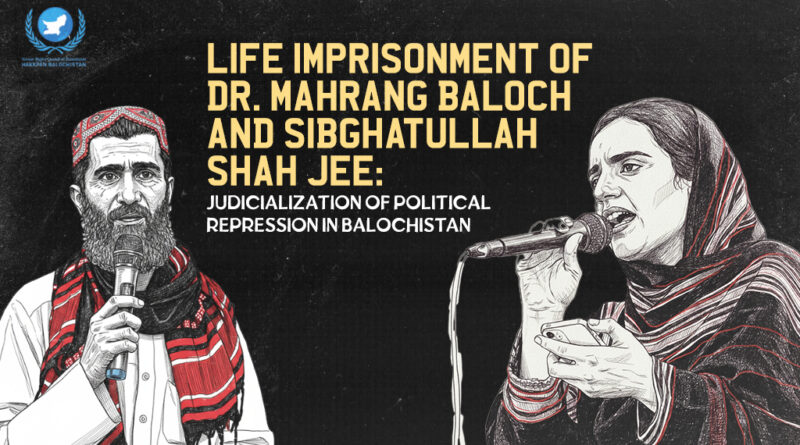
Life Imprisonment of Dr. Mahrang Baloch and Sibghatullah Shah Jee: Judicialization of Political Repression in Balochistan
The Human Rights Council of Balochistan (HRCB) unequivocally condemns the life imprisonment sentences imposed on Dr. Mahrang Baloch and Sibghatullah Shah Jee and expresses its grave concern regarding this development. The verdict constitutes a serious misuse of the justice system and reflects an escalation in the pattern of repression directed against peaceful political activism and human rights advocacy in Balochistan.
On 22 June 2026, an Anti-Terrorism Court (ATC) conducting proceedings inside Quetta’s Hudda District Jail sentenced the aforementioned Baloch Yakjehti Committee (BYC) leaders to two life terms of imprisonment and imposed a fine of PKR 200,000. The convictions relate to allegations arising from the Raji Muchi gathering in Gwadar on 29 July 2024, during which it was alleged that an FC personnel, Shabir Ahmad, was killed in the context of unrest involving protesters. The prosecution attributed unlawful assembly and responsibility for the death to two BYC leaders despite the absence of evidence directly linking them to the alleged act. This raises serious concerns regarding the evidentiary basis of the conviction and compliance with fair trial standards.
This verdict follows a prolonged period of detention and prosecution of BYC leaders and activists. Dr. Mahrang Baloch, Sibghatullah Shah Jee, Beebow Baloch, Gulzadi Baloch, and Bebarg Zehri have remained in detention since March 2025. They were initially detained under the Maintenance of Public Order (MPO) Ordinance, a preventive detention mechanism that permits imprisonment without criminal charge on the assertion of public order concerns. Upon expiration of the statutory detention period, the authorities did not release the detainees. Instead, multiple criminal proceedings were initiated and anti-terrorism provisions were applied, resulting in continued detention through successive remand orders.
The Raji Muchi gathering in Gwadar, organized by the BYC, included participation from thousands of individuals across Balochistan, including families of forcibly disappeared persons, students, women, political activists, and community members. The assembly sought to raise concerns regarding enforced disappearances, extrajudicial killings, militarisation, restrictions on political freedoms, and the broader human rights situation in the province.
Prior to the gathering, multiple restrictions were imposed on movement and participation, including road blockades, security checkpoints, arbitrary detentions, and harassment of individuals travelling toward Gwadar. Despite these measures, participation proceeded at a large scale, reflecting significant public engagement in peaceful political expression.
The response of the authorities involved the use of force against participants, resulting in the reported deaths of at least four civilians. Dozens of individuals sustained injuries, and several suffered long-term or permanent impairments. Documentation in the form of witness accounts, visual records, and medical evidence has been referenced in relation to these incidents. Concurrently, a broad campaign of legal action was initiated against BYC members and participants, including the registration of multiple criminal cases, raids on residences across Balochistan, and arrests, including instances of enforced disappearance.
No transparent or independent investigation was conducted into the use of force against civilians, nor accountability established in relation to the resulting casualties. Instead, legal and investigative attention were directed primarily toward organisers and participants of the gathering.
Following negotiations on 2 August 2024 between the Government of Balochistan and the Baloch Yakjehti Committee, an agreement was reached to conclude the protests. The agreement included assurances that FIRs and cases registered against participants and organisers would be withdrawn, excluding those related to death. These assurances were not implemented, and many of the FIRs remained active, later forming the basis for criminal proceedings against senior BYC leadership.
For a period thereafter, proceedings remained largely inactive. This situation changed following the events surrounding the Jaffer Express incident in March 2025. After a security operation, authorities transferred twenty-three bodies to Quetta Civil Hospital and identified them as militants. In the context of longstanding concerns regarding enforced disappearances and extrajudicial killings in Balochistan, families of missing persons gathered to identify the bodies. Access was denied, and several family members and activists were detained. Unidentified bodies were subsequently buried under state supervision.
On 20 March 2025, Counter Terrorism Department (CTD) personnel conducted raids in Quetta and detained BYC leader Bebarg Zehri, along with others. The following day, the use of force against protesters at a sit-in outside the University of Balochistan resulted in the deaths of three individuals, including a minor, and caused injuries to several others. These incidents further contributed to sustained protests across the province.
On 22 March 2025, several senior BYC leaders, including Dr. Mahrang Baloch and Beebow Baloch, were arrested. On 29 March 2025, Sibghatullah Shah Jee was detained following a raid on his residence in Quetta. During the same period, Gulzadi Baloch was also arrested.
The detained individuals were initially placed under preventive detention under Section 3 of the Maintenance of Public Order Ordinance. Following the expiry of the ninety-day statutory period in June 2025, the detainees were not released. Instead, additional criminal charges under anti-terrorism legislation were applied, ensuring continued detention.
A total of fifty-four FIRs were registered across multiple districts of Balochistan against BYC leadership between 2024 and 2025, including one from 2023. These cases relate to political activities, protests, sit-ins, and advocacy concerning enforced disappearances, extrajudicial killings, and human rights violations. Although many of these cases originated as public order matters, anti-terrorism provisions were subsequently invoked, transferring proceedings to Anti-Terrorism Courts.
Between July and October 2025, repeated remand orders were issued in relation to multiple FIRs. Rather than conducting consolidated proceedings, successive remands were pursued in separate cases, resulting in prolonged detention. Defence counsel has characterised this practice as a mechanism to circumvent procedural safeguards and prevent the implementation of release orders. Applications for bail and other legal remedies were consistently rejected by both the ATC and the Balochistan High Court.
Concerns regarding fair trial guarantees have persisted throughout the proceedings. Hearings were being conducted inside Quetta’s Hudda Jail, limiting public access and reducing oversight by journalists, independent observers, and civil society actors. The case concerning the death of FC personnel Shabbir Ahmad was initially heard in Gwadar and later transferred to Quetta. Proceedings were conducted through video-link arrangements from detention facilities. The victims boycotted proceedings in protest against restrictions affecting their legal defence. The court subsequently appointed state counsel; however, the victims reportedly declined engagement, citing lack of meaningful access to legal representation of their choice.
Serious concerns have also been raised regarding the evidentiary basis of the prosecution. According to information made public by the defence and the BYC, two FIRs related to the same incident contain contradictory accounts regarding the date of death of the FC personnel, recorded as 27 July 2024 in one instance and 29 July 2024 in another. These inconsistencies raise significant concerns regarding the integrity of the investigation and reliability of the prosecution’s narrative. Questions have also been raised regarding reports of an alternative cause of death involving a road accident during the same period.
The prosecution did not establish credible evidence directly linking either of the victims to the alleged incident. Notwithstanding these deficiencies, on 22 June 2026, the ATC convicted both leaders and imposed life imprisonment sentences.
The verdict stands in contrast to the absence of accountability for the deaths of four civilians during the Raji Muchi gathering and for the injuries sustained by numerous protesters. While extensive legal action has been taken against peaceful political actors, there has been no comparable process to investigate allegations of excessive use of force by security personnel.
The Human Rights Council of Balochistan considers that this verdict will have severe implications for civic space and human rights in the province. It sends a restrictive signal to victims of human rights violations, families of forcibly disappeared persons, and individuals seeking accountability through peaceful political means. The imprisonment of prominent human rights defenders further risks undermining public confidence in state institutions and deepening political exclusion.
This case reflects a persistent pattern in which anti-terrorism legislation, preventive detention, and criminal proceedings are used against political activists, students, journalists, and human rights defenders in Balochistan. The increasing reliance on judicial processes as mechanisms of control indicates a shift whereby repression is not only carried out through extrajudicial means but is also normalised through formal legal procedures. The continued use of force and suppression of political dissent and expression are among the main causes of the growing insurgency in Balochistan.
The HRCB calls for the immediate reversal of this verdict, the release of Dr. Mahrang Baloch and Sibghatullah Shah Jee, and an independent review of all cases registered against members of the Baloch Yakjehti Committee. The Council further calls for independent and transparent investigations into the deaths of civilians during the Raji Muchi gathering, the killings of protesters during March 2025, and all allegations of excessive use of force by security agencies.
